

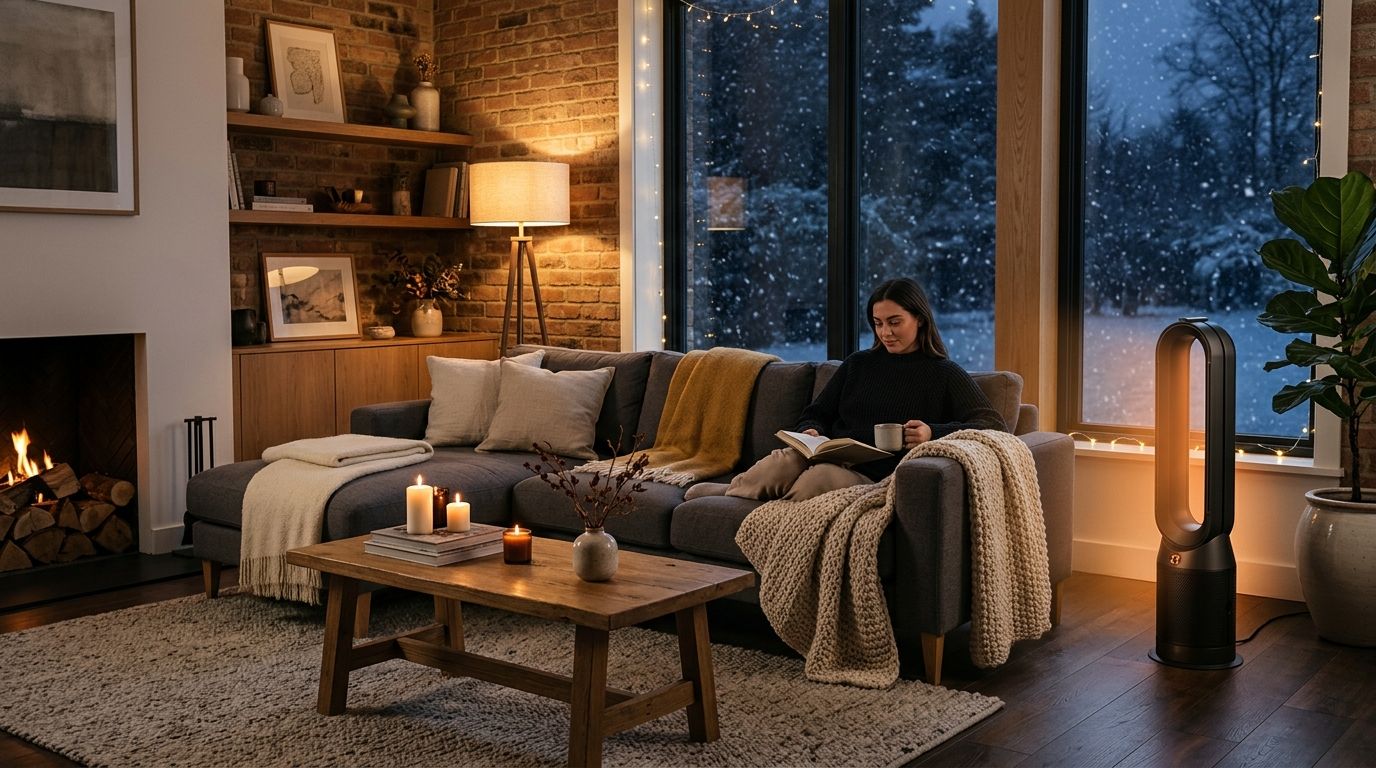
If you have ever turned on a small space heater in a big living room and felt nothing past arm's reach, you already know the problem. Most portable heaters are engineered for a compact bedroom or an under-desk footwell. Large family rooms, open floor plans, drafty basements, and cathedral-ceiling spaces demand a completely different thermal approach, and the wrong purchase leaves you chilly and frustrated.
This guide covers the best space heaters for large rooms available today. We evaluated published manufacturer specifications, thermal airflow engineering, safety certifications (such as ETL and UL listings), decibel ratings, and documented long-term owner feedback. We also break down the critical reality most guides gloss over: exactly how much thermal energy a single 120-volt plug-in heater can produce, so you never make a purchasing decision based on exaggerated marketing claims.
How to Choose the Best Space Heater for a Large Room
Finding the best space heater for large rooms requires understanding a fundamental electrical rule: virtually every portable residential heater in North America is limited to 1,500 watts, producing approximately 5,120 BTUs per hour. Because a standard 120-volt, 15-amp household circuit cannot safely supply higher continuous wattage, no single plug-in unit produces more raw thermal energy than another. The difference between an effective space heater and one that leaves you cold comes down to how effectively that heat is circulated, projected, and managed across your room.
For open floor plans, cathedral ceilings, and chilly basements, ceramic tower heaters equipped with high-velocity blowers and wide 70-degree to 120-degree oscillation offer the most balanced coverage. By projecting airflow forward at speeds up to 11.5 feet per second, they drive warm air into the room where people sit, rather than letting heat rise straight to the ceiling. If you primarily need direct warmth in a dedicated seating area, infrared quartz heaters deliver immediate radiant comfort to people and furniture without waiting for the entire 300-square-foot room to heat up. For bedrooms and quiet home offices, sealed diathermic oil radiators provide silent, steady convective warmth that retains heat well after the unit cycles off.
To help you pick the best model for your floor plan, we evaluated published manufacturer specifications, certified electrical safety standards (such as ETL and UL listings), digital thermostat precision, and long-term user feedback. Every heater featured below includes essential safety mechanisms, including mechanical tip-over cutoff switches, thermal overheat protection, and cool-touch exterior housings for safe everyday operation.
1. DREO 25-Inch Tower: Best Overall for Large Rooms
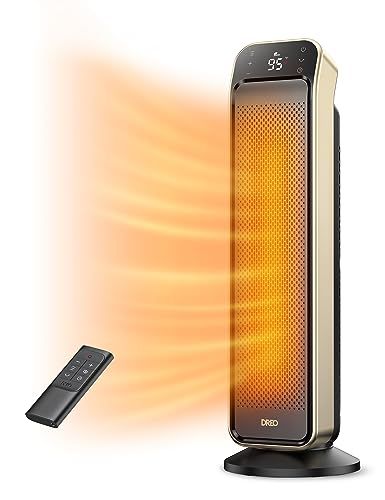
The DREO 25-inch tower heater represents the benchmark recommendation for most family rooms and living areas up to 250 square feet. The central engineering advantage of this model is its thermal delivery speed. While cheaper towers let heat slowly float upward toward the ceiling, DREO utilizes an extended centrifugal impeller that drives warm air outward at approximately 11.5 feet per second.
This velocity propels warm air across the floor where you are actually sitting rather than pooling heat directly in front of the heater grill. Combined with a smooth 70-degree oscillation cycle, the unit distributes heat evenly across rooms ranging from 100 to 270 square feet without producing aggressive hot spots.
Acoustic performance is equally impressive. Running in its lower modes, the motor produces noise levels as low as 25 dB, which is quieter than a whisper and virtually imperceptible over ambient room sounds. Control options include a digital thermostat that adjusts in single-degree increments from 41°F to 95°F, an ECO mode that modulates power consumption dynamically, a multi-function remote control, and an integrated child lock.
Key Specifications
- Heating Element: PTC Ceramic with Hyperamics airflow casing
- Maximum Power: 1,500 Watts (5,120 BTU/hr)
- Oscillation Sweep: 70 degrees
- Noise Rating: As low as 25 dB
- Thermostat Range: 41°F to 95°F (1-degree increments)
- Safety Certifications: ETL listed, tip-over switch, overheat sensor, flame-retardant V-0 casing
What We Liked
- Fast, direct convective airflow that reaches seating areas over 10 feet away.
- Exceptionally quiet sound signature that never interferes with conversation or sleep.
- Precise single-degree digital thermostat adjustments with power-saving ECO mode.
- Comprehensive safety protections including mechanical tip-over sensor and child lock.
Things to Consider
- The LED display shows your target setpoint rather than ambient room temperature.
- Runs the fan for roughly 15 seconds after powering off to cool down internal ceramic elements.
- In poorly insulated spaces exceeding 300 square feet, a single unit works best as supplemental heat.
2. DREO 30-Inch Tower: Best for the Biggest Rooms
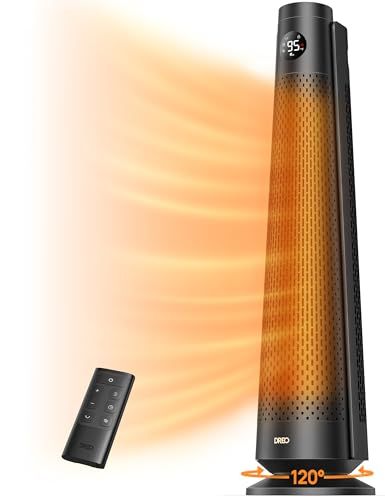
For expansive open-concept living rooms, connected dining spaces, and finished basements up to 300 square feet, the 30-inch DREO tower is the heavy-duty upgrade. It packs a larger 308-millimeter PTC ceramic core that increases the heating contact surface area, pushing warm air with greater volume.
The defining feature of this model is its adjustable oscillation arc. While standard towers are locked into a single fixed angle, this model lets you toggle between 30, 60, 90, and 120 degrees of sweep. In a wide family room, the 120-degree setting bathes an entire sectional and perimeter seating in consistent warm air. In an elongated room, narrowing the oscillation to 30 or 60 degrees focuses thermal energy exactly where family members gather.
It offers five distinct heat output settings plus three fan-only modes, a 1-to-12 hour auto shutoff timer, and eight integrated safety safeguards. Owners frequently report strong heating performance even in challenging environments like homes with exposed brick and concrete basement floors.
Key Specifications
- Heating Element: Enlarged 308mm PTC Ceramic matrix
- Power Settings: 5 heat levels (up to 1,500 Watts) + 3 fan speeds
- Oscillation Sweep: 30°, 60°, 90°, or 120° selectable
- Coverage Rating: Up to 300 square feet
- Noise Rating: 25 dB to 38 dB
- Height & Weight: 29.8 inches tall, approximately 8.2 lbs
What We Liked
- Industry-leading 120-degree oscillation angle covers expansive open floor plans.
- Substantially larger ceramic heating core produces higher thermal air volume.
- Customizable sweep angles allow focused spot heating or full-room dispersion.
- Quiet operation backed by an extensive array of electrical safety features.
Things to Consider
- Taller profile and larger footprint require more dedicated floor space.
- Priced at a premium compared to compact 24-inch to 25-inch models.
- Still bound by 1,500W household electrical caps in uninsulated spaces.
3. Dr Infrared DR-968: Best for Fast, Noticeable Warmth
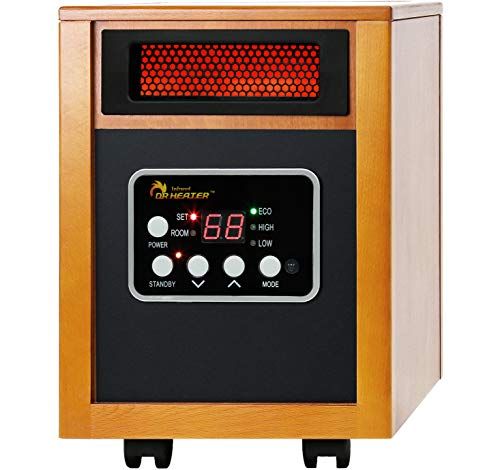
The Dr Infrared DR-968 operates on a fundamentally different thermal principle than conventional convective towers. Rather than relying solely on heating air and hoping it circulates, this retro-styled box heater pairs an advanced infrared quartz tube with a secondary PTC ceramic element.
Infrared radiation warms physical objects, furniture, and human skin directly, mirroring the sensation of standing in sunlight. This means you feel noticeably warm within seconds of activating the heater, even if the surrounding air in a cavernous basement is still chilly. For someone sitting on a sofa or working at a workbench, it produces immediate, soothing comfort without drying out nasal passages the way high-speed forced-air blowers often do.
The unit carries a strong pedigree as one of the most purchased and reviewed space heaters on the market. It features an aluminum low-noise blower operating around 39 dB, a 3-year limited warranty, full UL safety listing, tip-over and overheat shutoffs, and caster wheels for mobility.
Key Specifications
- Heating Technology: Dual system (Infrared Quartz Tube + PTC Ceramic)
- Thermal Output: 1,500W High (5,200 BTU/hr), 1,000W Low
- Noise Level: Approximately 39 dB
- Safety Listing: UL Listed (Underwriters Laboratories)
- Warranty: 3-Year Limited Manufacturer Warranty
- Form Factor: Wooden cabinet styling on caster wheels
What We Liked
- Immediate radiant warmth you feel on your skin within seconds.
- Gentle on dry winter skin and sinuses compared to high-velocity fan blasts.
- Proven reliability with a 3-year manufacturer warranty.
- Heavy-duty UL electrical safety certification.
Things to Consider
- Boxy footprint does not oscillate, focusing heat primarily in a forward cone.
- Draws approximately 12.5 amps continuously; must not share an outlet with high-draw appliances.
- Heavier unit (around 24 lbs) compared to lightweight plastic towers.
4. Lasko 29-Inch Digital Ceramic Tower (5586): Best Value with a Digital Display
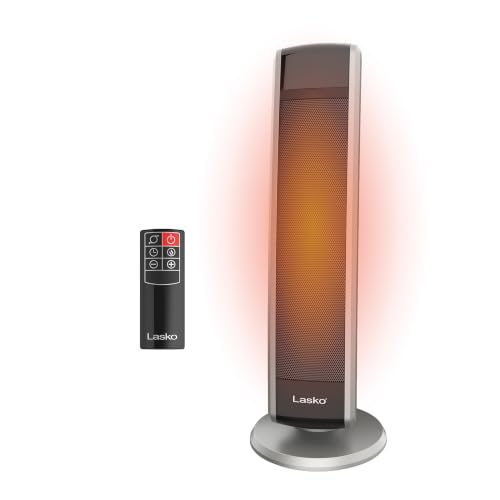
Lasko is one of the most established brands in domestic climate equipment, and this 29-inch digital ceramic tower is a longstanding favorite for buyers seeking dependable warmth without paying premium prices. Frequently available around the $60 mark, it provides full 1,500-watt heating capacity paired with an intuitive digital interface and a multi-function remote control that docks directly onto the back of the chassis.
The heater features two quiet comfort settings (High at 1,500W and Low at 900W), an 8-hour auto-off timer, and widespread oscillation that sweeps warm air across living room seating. Its slender profile tucks cleanly into room corners or beside sofas without dominating floor space, and an integrated carry handle makes room-to-room repositioning straightforward.
While it lacks the ultra-high velocity impeller technology found in DREO towers, for medium-to-large family rooms where occupants sit within eight to twelve feet of the unit, it delivers reliable, consistent warmth backed by a 3-year limited warranty.
Key Specifications
- Heating Core: Self-regulating ceramic element
- Power Draw: 1,500 Watts High / 900 Watts Low
- Controls: Digital display with programmable thermostat & 8-hour timer
- Oscillation: Widespread mechanical sweep
- Safety Listing: ETL listed with patented Blue Plug circuit protector
- Warranty: 3-Year Limited Warranty
What We Liked
- Excellent performance-to-price ratio from a venerable domestic brand.
- Convenient on-board remote control storage slot.
- Slim, unobtrusive vertical footprint that fits in tight corners.
- Self-regulating ceramic element with built-in safety plug fuse.
Things to Consider
- Airflow projection does not travel quite as far across huge open spaces as premium centrifugal towers.
- Thermostat steps in broader increments compared to 1-degree precision units.
- Better matched for medium-to-large rooms rather than vast cathedral-ceiling halls.
5. DREO Oil-Filled Radiator: Best for Silent, Steady Heat
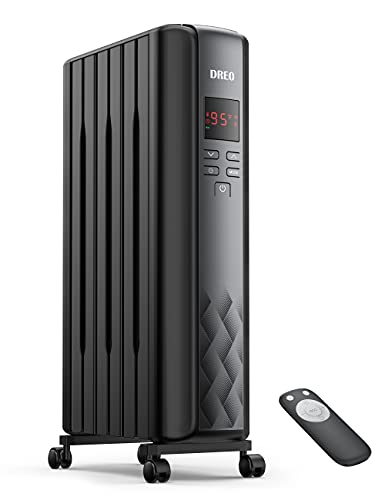
Fan noise is the primary complaint leveled against portable space heaters. An oil-filled radiator eliminates fan noise entirely because it does not have a motor or fan blades. Instead, an electrical element warms permanently sealed diathermic oil inside heavy-gauge metal fins. As the oil circulates internally, the fins radiate heat silently and create natural convective air currents that warm the room continuously.
DREO upgrades this classic radiator concept with contemporary digital controls. The unit features eight specialized M-shaped fins that expand heat-dissipation surface area, warming up faster than older accordion-style radiators. Users can select between 600W, 900W, and 1,500W power tiers, or activate an intelligent ECO mode that holds room temperature within 1°F between 41°F and 95°F.
Because oil has high thermal mass, it retains heat and continues warming the room long after the power cycles off. It is completely silent aside from faint thermostat clicks, preserves ambient humidity, and features smooth-rolling caster wheels for effortless relocation.
Key Specifications
- Heating Technology: Permanently sealed diathermic oil with 8 M-shaped fins
- Power Settings: 600W, 900W, 1,500W + Smart ECO Mode
- Acoustic Rating: Completely silent (0 dB fan noise)
- Timer & Controls: 24-hour timer, digital display, remote control
- Mobility: 360-degree swivel wheels and integrated handle
- Safety Protections: Tip-over sensor, thermal cutoff, flame-resistant construction
What We Liked
- Whisper-silent operation makes it the premier choice for master bedrooms and media rooms.
- Maintains room humidity and does not dry out air or stir up dust and pet dander.
- Substantial thermal retention continues radiating heat after the thermostat shuts off.
- Three selectable wattage modes prevent breaker trips on shared circuits.
Things to Consider
- Takes 15 to 25 minutes to warm up compared to instant ceramic fan heaters.
- Heavier and bulkier unit that requires clear floor space around metal fins.
- Infrared remote requires a direct line of sight to the front control display.
6. Lasko 751320 Ceramic Tower: Best Budget Pick
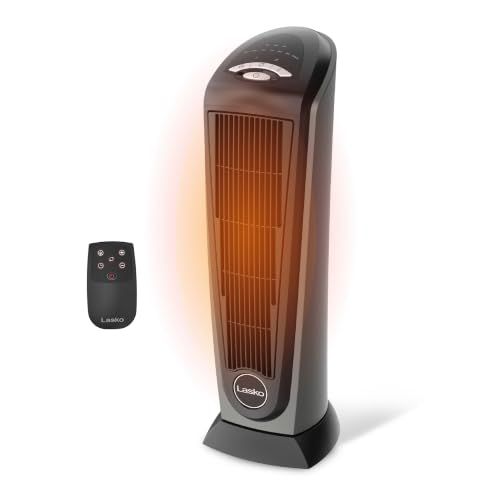
Not every homeowner needs sophisticated digital climate algorithms. The Lasko 751320 is a straightforward, budget-friendly 1,500-watt ceramic tower equipped with a digital thermostat, an 8-hour timer, and widespread oscillation. Regularly selling in the mid-$50 range, its self-regulating ceramic element, cool-touch exterior housing, and ETL safety listing make it a solid option for budget-minded shoppers.
We want to be direct about its operational envelope: Lasko designates this model primarily for small-to-medium rooms. We include it in this large-room guide because many homeowners with expansive floor plans do not need to heat the entire 400-square-foot footprint; they only need targeted warmth around an armchair, reading nook, or desk. In those scenarios, this compact tower does the job without unnecessary cost.
It is also a practical choice as a secondary heater to complement an existing radiator or central HVAC register on unusually cold winter nights.
Key Specifications
- Element Type: Self-regulating ceramic block
- Maximum Power: 1,500 Watts
- Oscillation: Widespread mechanical sweep
- Controls: Push-button digital controls with remote
- Safety Listing: ETL certified with fused safety plug
What We Liked
- Highly accessible price point for a full 1,500-watt oscillating heater.
- Includes full-function remote control with on-chassis storage.
- Cool-touch exterior prevents burns if brushed against by pets or children.
- Compact and lightweight for easy transport between rooms.
Things to Consider
- Not engineered for whole-room heating across expansive open spaces.
- Noticeable fan sound on high setting compared to modern ultra-quiet impellers.
- Basic aesthetic and plastic housing compared to premium models.
7. Vornado TAVH10: Best for Even Airflow in Mid-Size Rooms
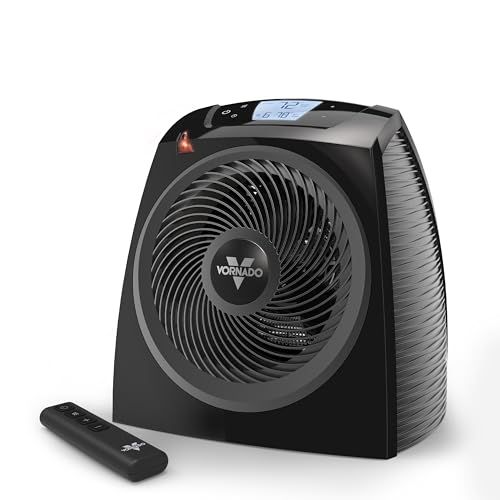
Vornado approaches space heating from an aerodynamic perspective. Rather than oscillating back and forth in an attempt to sweep air across an arc, the TAVH10 employs Vornado's signature Vortex Action. Its deep-pitch propeller blades and spiral grill create a focused beam of swirling air that travels across the room, reflects off opposing walls and ceilings, and establishes continuous whole-room air circulation.
This continuous convective loop effectively eliminates the “hot near the heater, freezing ten feet away” microclimate problem. The TAVH10 incorporates advanced auto climate control that senses ambient temperature and modulates both fan speed and element wattage to maintain your setpoint smoothly without annoying on-off cycling.
The realistic caveat is room size: Vornado positions the TAVH10 for spaces up to roughly 150 to 200 square feet. We highlight it as an honorable mention for homeowners who value uniform, draft-free circulation in connected dining areas or mid-sized dens. Crucially, Vornado backs this unit with an industry-leading 5-year satisfaction guarantee, far outlasting the 1-year coverage typical of most competitors.
Key Specifications
- Circulation Technology: Vortex aerodynamic whole-room circulation
- Power Modulation: Automatic heat and fan speed staging (up to 1,500W)
- Safety Features: Automatic tip-over switch, thermal cutoff, cool-touch cabinet
- Warranty: 5-Year Manufacturer Warranty
- Controls: Digital push-button interface with remote control
What We Liked
- Vortex aerodynamics eliminate cold pockets and create uniform floor-to-ceiling warmth.
- Auto climate control modulates output gracefully without abrupt on-off clicks.
- Exceptional 5-year warranty demonstrates superior manufacturing quality.
- Cabinet exterior remains cool to the touch even during prolonged high-heat runs.
Things to Consider
- Officially rated for mid-sized rooms; lacks raw push for cavernous basements.
- Higher price tag relative to basic oscillating towers.
- Stationary design requires proper positioning against a wall to establish vortex circulation.
How Big Is “Large”? The Realistic Math on Room Size
Most buying guides gloss over a fundamental thermodynamic fact that dictates whether you will be satisfied with your space heater purchase.
A standard 1,500-watt electric heater generates approximately 5,120 BTUs (British Thermal Units) per hour. That is the hard mathematical ceiling of any plug-in heater operating on a conventional 120-volt, 15-amp household circuit. As a standard engineering rule of thumb, heating residential spaces with standard 8-foot ceilings and average insulation requires approximately 10 watts of power per square foot.
By that direct formula, one 1,500-watt heater provides sufficient thermal energy to heat approximately 150 square feet as an independent, primary heat source.
Why, then, do product packaging and retail pages regularly claim coverage of 250, 300, or even 500 square feet? Because those coverage numbers assume supplemental heating: the room is already heated to 62°F or 65°F by your home's central furnace or boiler, and the space heater is merely elevating the ambient temperature by 5 to 8 degrees in the specific zone you occupy.
- Up to 150 sq ft: One 1,500-watt unit can serve as the primary heating source.
- 150 to 300 sq ft: One high-velocity tower heater provides effective supplemental warmth, especially when using oscillation and sitting within 10 to 12 feet.
- 300 sq ft and above: Do not expect a single plug-in heater to warm an entire cold, uninsulated space on its own. Position two heaters in separate zones on different electrical circuits, or combine the unit with central heating.
Ceiling height, window surface area, and floor materials also dramatically alter heating demand. A room with 12-foot vaulted ceilings, drafty double-hung windows, or an uninsulated concrete floor loses heat substantially faster than a carpeted room with standard ceilings. In drafty spaces, weatherstripping windows and installing door sweeps often delivers greater warmth improvements than buying a second heater.
What to Look for When Buying a Space Heater for a Large Room
When evaluating heaters for open spaces, prioritize the following engineering criteria:
1. Heating Technology & Architecture
- Ceramic (PTC) Towers: Combine fast ceramic heating with a tall vertical grill and motor-driven fan. They oscillate to disperse air across wide floor areas and represent the most versatile choice for large living rooms.
- Infrared Quartz Heaters: Emit radiant electromagnetic energy that warms physical bodies and objects directly. They feel hot almost instantaneously and excel at spot comfort, though they warm ambient air more gradually.
- Oil-Filled Radiators: Provide silent, sustained thermal radiation with excellent heat retention. They take longer to reach operating temperature but maintain stable warmth without air drying.
- Vortex Circulators: Propel focused air currents that reflect off walls and ceilings to generate continuous whole-room air mixing.
2. Impeller Velocity & Oscillation Range
In a large room, convective velocity matters far more than element wattage. Look for centrifugal impellers capable of pushing air past 10 feet per second. Oscillation angles between 70 and 120 degrees prevent heat from stagnating in a narrow tunnel.
3. Digital Thermostats & ECO Modulation
Basic heaters rely on crude bimetallic strips that cause wide temperature swings. Premium models feature electronic digital thermostats that adjust in 1-degree increments. Intelligent ECO modes continuously adjust wattage draw between low, medium, and high to maintain your target setpoint with minimum electricity consumption.
4. Acoustic Decibel Performance
If you intend to run the heater in a living room while watching television or in a home office during conference calls, verify acoustic ratings. Units operating between 25 dB and 35 dB are considered whisper-quiet. Oil-filled radiators operate at 0 dB fan noise.
5. Mandatory Safety Protections
High-current appliances must never compromise on safety. Always demand:
- Mechanical Tip-Over Protection: Shuts off power immediately if the unit is knocked over by a pet or child.
- Thermal Overheat Limiters: Cuts electrical current if internal temperatures exceed safe operating limits.
- Recognized Electrical Listing: Independent testing certification by ETL (Intertek) or UL (Underwriters Laboratories).
- V-0 Flame Retardant Housing: Prevents combustion even under extreme internal thermal stress.
How Much Does It Cost to Run a Space Heater?
Calculating the electrical operational cost of a 1,500-watt space heater is straightforward:
Hourly Cost = 1.5 kW × Electricity Rate per kWh
At an average United States electricity rate of 17 cents per kilowatt-hour:
- 1 Hour at Continuous 1,500W: 1.5 kW × $0.17 = ~$0.26 per hour
- 8 Hours at Continuous Full Power: ~$2.04 per day
- 30 Days of 8-Hour Continuous Runs: ~$61.20 per month
In real-world use, a heater governed by an accurate digital thermostat or ECO mode does not run continuously at 1,500 watts. Once your room reaches the setpoint, the unit cycles off or drops to 600W or 900W to maintain temperature, reducing real electricity expenses by 30% to 50%.
The most financially effective strategy is zone heating: set your central whole-house furnace thermostat down to 64°F or 66°F, and use an efficient space heater to warm only the living room or home office you are actively occupying. Heating 250 square feet locally is significantly cheaper than heating an entire 2,500-square-foot house to 72°F.
Space Heater Safety Guidelines
Portable electric heaters are dependable appliances when operated responsibly. Follow these fundamental safety rules:
- Always Plug Directly into a Wall Receptacle: Never use extension cords, surge protectors, or smart plugs. A 1,500-watt heater draws approximately 12.5 amps continuously, which can melt lightweight extension cords and cause electrical fires.
- Maintain the Three-Foot Clearance Perimeter: The National Fire Protection Association (NFPA) mandates maintaining at least three feet of empty space around the heater, keeping it clear of curtains, bedding, upholstered furniture, rugs, and paper.
- Place on Firm, Flat Flooring: Never place a space heater on a table, shelf, soft rug, or sofa where it could tip over or obstruct intake grills.
- Avoid Dedicated Circuit Overloading: A standard 15-amp circuit breaker handles 1,800 watts maximum before tripping. A 1,500W heater uses nearly the entire capacity. Do not run hair dryers, microwaves, or vacuums on the same circuit simultaneously.
- Never Leave Operating Unattended: Turn off the heater and unplug it when leaving the room or retiring for the evening, or utilize an automated shutoff timer.
Which Space Heater Should You Choose?
To summarize our findings based on room layout and household priorities:
- Best Overall for Most Homes: DREO 25-Inch Tower. High airflow speed, whisper-quiet 25 dB acoustics, and precise digital temperature control.
- Best for Expansive Floor Plans: DREO 30-Inch Tower. 120-degree customizable oscillation sweep and enlarged 308mm ceramic heating element.
- Best for Instant Direct Warmth: Dr Infrared DR-968. Radiant quartz infrared technology that warms people directly without drying room air.
- Best Value with Digital Remote: Lasko 29-Inch Tower (5586). Proven reliability, digital controls, and widespread oscillation at a modest price.
- Best for Silent Master Bedrooms: DREO Oil-Filled Radiator. Completely silent natural convection with excellent thermal retention.
If you remain uncertain, the DREO 25-inch tower represents the safest, most versatile starting point for virtually any large room configuration.
Frequently Asked Questions
For most buyers, the DREO 25-inch tower is the best all-around option, thanks to fast airflow, quiet operation, and a precise digital thermostat. For rooms close to 300 square feet, the DREO 30-inch with adjustable oscillation up to 120 degrees is a stronger fit.

Clara Hughes
Author, Home & Living
Clara Hughes covers space heaters, air purifiers, and everyday home products. She focuses on comparing heating coverage, safety features, noise levels, and buyer feedback so readers can find the right fit for their living space.