
If you spend eight, ten, or twelve hours a day sitting at a desk, your chair is the single most critical piece of health equipment in your workspace. Most people spend thousands of dollars on high-end laptops, dual monitors, and noise-canceling headphones, only to perch their spines on an unsupportive, flat-padded dining chair or a flashy gaming bucket seat. Within three hours, the consequences arrive: a dull ache in the lumbar spine, stiffness in the neck, numbness in the hamstrings, and the nagging urge to slouch forward toward the screen.
The human spine was never designed for prolonged static sitting. When you sit upright on an unsupportive surface, your pelvis tilts backward, your lumbar curve collapses from its natural inward arch into a rounded posture, and spinal disc pressure at the L4-L5 vertebrae spikes by over 40 percent compared to standing. Over months of remote work or intensive college study sessions, poor seating ergonomics leads to chronic disc compression, sciatica flare-ups, and repetitive strain.
Finding the best ergonomic chair is not about finding the softest cushion; it is about finding a mechanical structure that maintains your neutral spinal alignment, disperses your body weight across your pelvic bones, encourages dynamic micro-movement, and fits your specific body dimensions and workspace. To help you make an informed decision, this guide breaks down the seven best ergonomic office chairs of 2026 for long-term sitting, back pain relief, and focused study environments.
The Biomechanics of Sitting: Why Your Back Hurts
To choose the right chair, it helps to understand what happens to your anatomy when you sit down. In a standing position, your spine naturally forms an S-curve: your cervical (neck) and lumbar (lower back) regions curve slightly forward, while your thoracic (mid-back) curves outward. This geometry distributes mechanical load evenly across vertebral bodies and shock-absorbing intervertebral discs.
When you sit on a conventional flat chair, your thighs form a 90-degree angle with your torso. This position pulls on your hamstring tendons, rotating your pelvis backward by approximately 15 to 20 degrees. When the pelvis rotates backward, the natural inward curve of your lower back (lumbar lordosis) flattens out entirely.
According to orthopedic spinal research originally documented by Dr. Alf Nachemson and expanded across clinical biomechanics journals, the internal fluid pressure inside your L4-L5 intervertebral disc changes dramatically depending on posture:
- Standing upright in neutral alignment: 100% baseline pressure.
- Lying flat on your back: 25% baseline pressure.
- Sitting upright with proper lumbar support: 140% baseline pressure.
- Sitting upright without lumbar support: 150% baseline pressure.
- Slouching or hunching forward toward a keyboard: 185% to 200% baseline pressure.
When you spend eight hours hunched over a laptop without lumbar stabilization, you are subjecting your lower spinal discs to roughly double the mechanical compression they experience when you walk. Without a chair that actively pushes your sacrum and lower lumbar region forward, your back extensor muscles must stay contracted all day to prevent you from tumbling forward. That continuous isometric muscle contraction creates metabolic waste buildup, leading directly to the burning muscle fatigue and spasms familiar to desk workers.
1. Herman Miller Aeron: Best Overall for All-Day Sitting
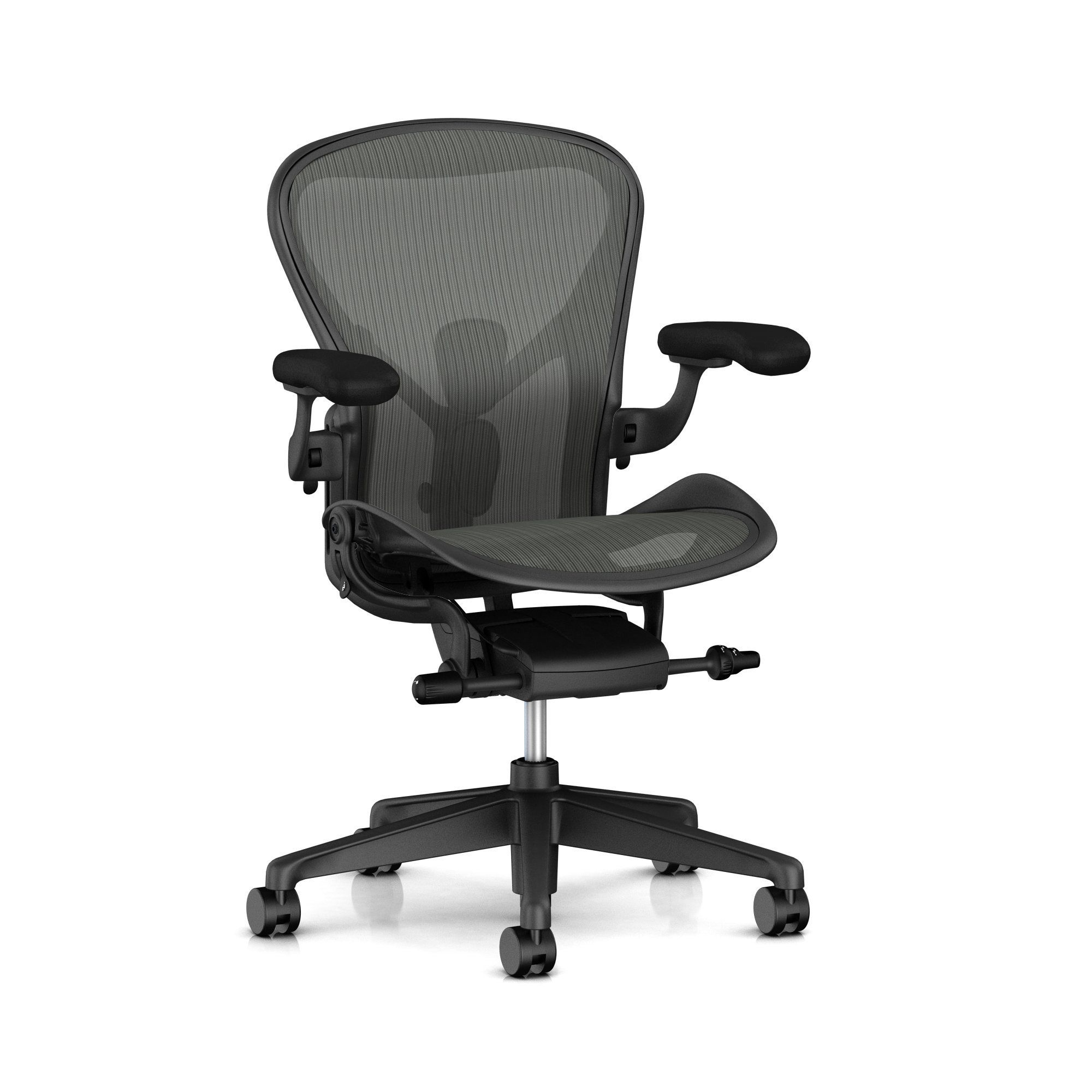
Originally engineered by Bill Stumpf and Don Chadwick and remastered in 2016, the Herman Miller Aeron remains the gold standard for full-time desk professionals who sit for eight to twelve hours daily. While many chairs attempt to mimic its appearance, the Aeron stands apart because of its proprietary 8Z Pellicle suspension textile and its kinematic harmonic tilt mechanism.
Unlike conventional mesh that feels like a stiff window screen, 8Z Pellicle is woven with eight distinct zones of varying lateral and longitudinal tension across the seat pan and backrest. At the edges where your pelvic bones and thighs contact the frame, the weave is tight and supportive to keep you centered. In the middle where your ischial tuberosities (sit bones) rest, the weave yields gently to eliminate peak pressure points. Because the entire chair is suspended mesh with zero foam padding, it allows body heat and moisture to dissipate continuously, eliminating the uncomfortable heat buildup that plagues leather and thick foam chairs during afternoon crunch sessions.
Equally critical is Herman Miller's PostureFit SL mechanism. Instead of merely pressing a single pillow into your lumbar spine, PostureFit SL uses two independent, adjustable pads: one stabilizes the base of your sacrum to prevent backward pelvic rotation, while the upper pad supports the lumbar lordotic curve. This dual stabilization locks your pelvis into a natural neutral forward tilt, effortlessly keeping your spine in an upright, healthy posture without requiring conscious muscular effort.
The Aeron also features a forward-tilt mechanism, allowing the seat pan to angle forward by 5 degrees for intensive, focused typing and document markup. It is manufactured in three distinct, dedicated frame sizes (A, B, and C) rather than attempting a one-size-fits-all compromise, ensuring users from 4'10" to 6'6" receive exact popliteal clearance and backrest alignment.
Key Specifications
- Seating Technology: 8Z Pellicle elastomeric suspension mesh (8 tension zones)
- Lumbar Architecture: Dual-pad PostureFit SL with independent sacral and lumbar dials
- Recline Mechanism: Harmonic 2 tilt with forward-tilt engagement (up to 5° forward) and tilt limiter
- Armrest Adjustability: Fully adjustable 4D arms (height, depth, pivot angle, slide)
- Sizing Options: Size A (Small), Size B (Medium, fits ~85% of users), Size C (Large)
- Weight Capacity: Up to 350 lbs (B and C) / 300 lbs (Size A)
- Durability Certification: ANSI/BIFMA X5.1 rated with 12-year 24/7 commercial warranty
What We Liked
- 8Z Pellicle suspension completely eliminates pressure hotspots across the sit bones and thighs.
- Exceptional breathability keeps the seated body cool and dry across long summer workdays.
- PostureFit SL stabilizes the sacrum directly, preventing backward pelvic tilt at the source.
- Forward-tilt feature is outstanding for intensive writing, coding, and close desk inspection.
- Commercial-grade aluminum construction built to last well over a decade of daily abuse.
Things to Consider
- The rigid composite perimeter frame can press into thighs if you like to sit cross-legged or curl one leg under.
- Premium investment price point compared to standard consumer office furniture.
- Does not come standard with an integrated headrest (third-party attachments required).
2. HON Ignition 2.0: Best Mid-Range Commercial Workhorse
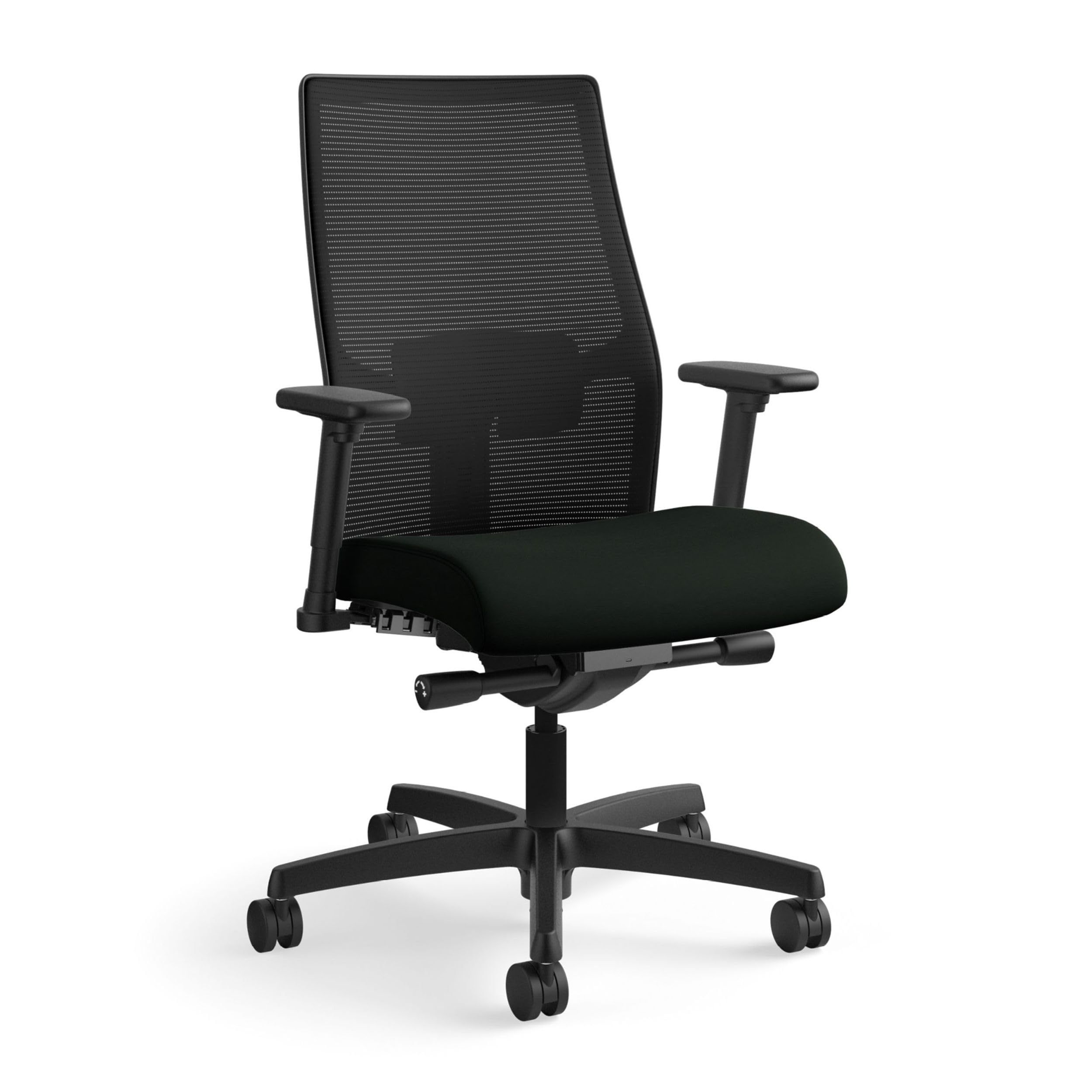
For buyers who want authentic commercial-grade durability and ergonomic engineering without paying four figures, the HON Ignition 2.0 is widely regarded across corporate facilities management as the premier mid-tier workhorse. Manufactured by The HON Company in Iowa, the Ignition 2.0 is designed specifically for intensive multi-shift office environments.
The defining feature of the Ignition 2.0 is its hybrid construction. While all-mesh chairs can feel uncomfortably firm around the perimeter frame for some body shapes, the Ignition combines a breathable four-way stretch polyester mesh backrest with a thick, contoured high-resilience molded foam seat cushion. Rather than using cheap cut foam that compresses into a flat pancake after six months, HON utilizes high-density cold-cured foam that retains its elasticity and spring-back resistance over years of daily eight-hour shifts. The cushion features a subtle waterfall front edge that relieves pressure along the femoral arteries and sciatic nerve in the underside of your thighs.
Adjustability is another core strength. The Ignition 2.0 features an advanced synchro-tilt mechanism that reclines the backrest at a 2:1 ratio to the seat pan, keeping your feet planted while allowing you to open your hip angle. It includes an adjustable lumbar support bar that slides vertically along the backrest frame to match your spine height, height-and-width adjustable armrests, and an optional sliding seat-glide mechanism that shifts the cushion forward and backward by two inches to accommodate varying leg lengths.
Key Specifications
- Seat Construction: High-density contoured molded foam with spill-resistant commercial upholstery
- Backrest Material: Breathable 4-way stretch elastomeric mesh
- Tilt Architecture: Advanced synchro-tilt with tilt tension knob and upright tilt lock
- Seat Depth: Available with optional seat-glide mechanism (2 inches of travel)
- Lumbar Adjustment: Vertical sliding lumbar beam (3.5 inches of travel)
- Weight Capacity: 300 lbs continuous commercial rating
- Standards: ANSI/BIFMA X5.1 compliant
What We Liked
- High-density molded foam seat provides plush cushioning that will not bottom out over time.
- Four-way stretch mesh back conforms naturally to individual thoracic curves.
- Sliding seat pan depth adjustment accommodates both shorter and taller leg lengths.
- Proven track record across corporate headquarters with extensive parts availability.
- Excellent structural stability backed by a robust five-star reinforced nylon base.
Things to Consider
- Armrests adjust for height and width, but lack rotational 3D pivot angles.
- Lumbar support bar adjusts up and down, but does not provide depth-tension adjustment.
- Foam cushion retains more heat than an all-mesh chair during hot summer afternoons.
3. QLTPLUS Ergonomic Split-Backrest: Best for Lower Back Pain & Sciatica
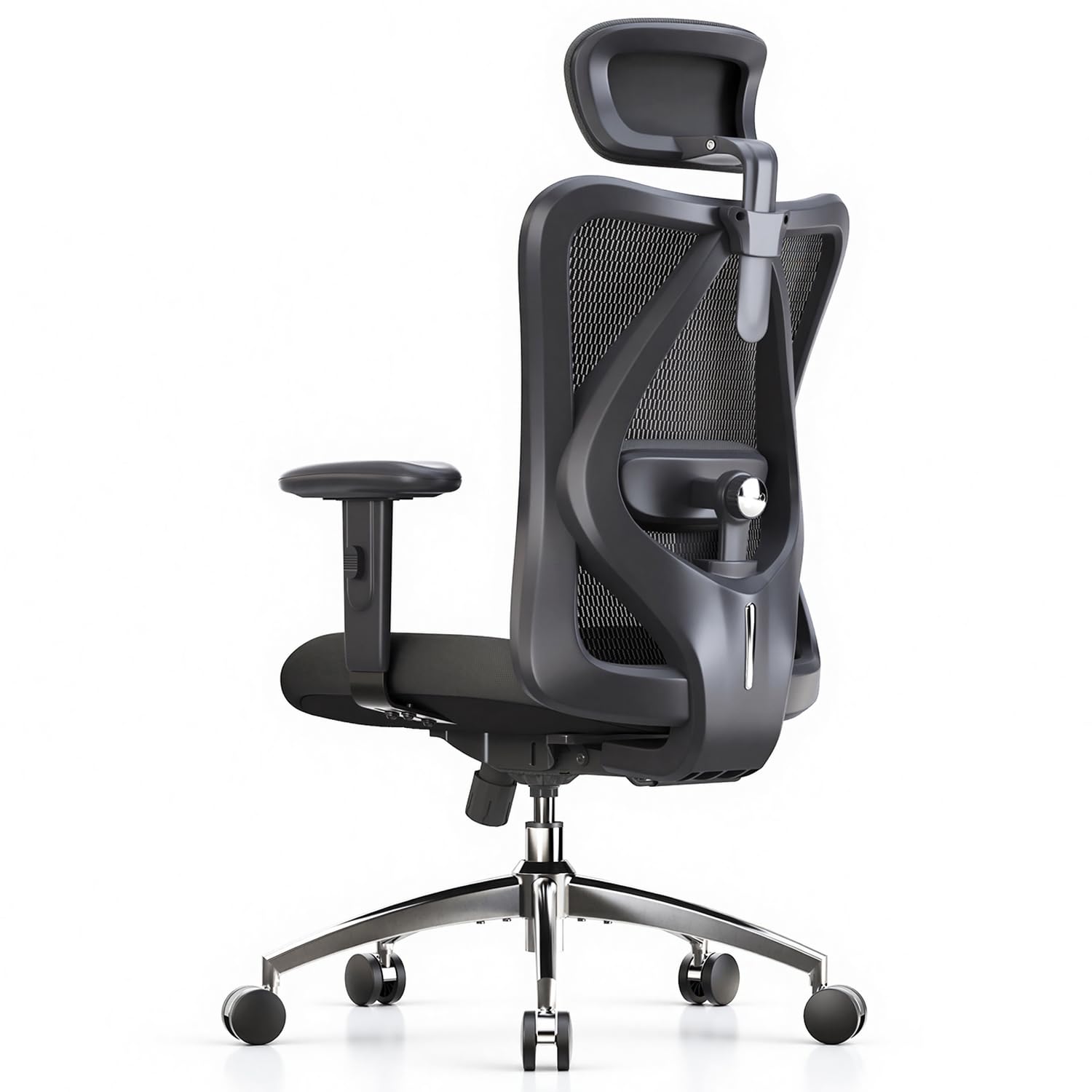
If your primary reason for shopping is persistent lower back pain, sciatica, or sacral tenderness, conventional flat-backrest chairs often fail to deliver relief because they only support your spine when you sit perfectly rigid and motionless. The moment you lean to one side to reach a mouse or turn your torso toward a second display, your lower back loses contact with the lumbar pad.
The QLTPLUS Ergonomic Chair solves this problem with its patented split-backrest dynamic wing architecture. Instead of a single piece of stretched mesh, the lower lumbar region is split into two independent, anatomically curved wings mounted on heavy-duty omnidirectional coil springs. When you sit back, the two wings pivot inward to wrap around your lower thoracic and lumbar vertebrae, cradling your lower back like a supportive brace.
Crucially, when you shift your weight, twist to answer a phone, or stretch to type on a separate keypad, the left and right wings compress independently. This ensures continuous, active physical contact with your lumbar spine regardless of your seated angle, preventing the sudden loss of spinal support that triggers muscle spasms and sciatic nerve compression.
Complementing the split backrest is a deeply contoured, high-density waterfall seat cushion that distributes pressure away from your coccyx (tailbone). For midday rest or reading long documents, the chair features an integrated, hideaway padded footrest that slides out from beneath the seat pan, paired with a multi-angle tilt mechanism that reclines securely from 90 degrees up to 135 degrees.
Key Specifications
- Backrest Engineering: Dual-wing split lumbar with omnidirectional responsive springs
- Cushion Technology: 3.8-inch high-density resilient molded foam with waterfall thigh contour
- Recline Range: 90° to 135° multi-lock recline mechanism
- Footrest: Integrated retractable steel-rail padded footrest
- Headrest: 2D curved headrest with height and angle adjustability
- Armrests: 3D linkage armrests that move synchronously with backrest recline
- Weight Capacity: 330 lbs with certified Class 4 heavy-duty pneumatic gas lift
What We Liked
- Dual split wings provide active, dynamic lumbar support even when shifting or turning sideways.
- Noticeable reduction in tailbone pressure thanks to the thick, ergonomic waterfall cushion.
- Retractable footrest and 135-degree recline allow restful reading breaks without leaving your desk.
- Heavy-duty Class 4 gas lift cylinder ensures stable height maintenance without slow sinking.
- Excellent overall value for home workers and individuals managing recurrent back stiffness.
Things to Consider
- The dual-wing sensation feels noticeably more hugging and pronounced than a traditional flat backrest.
- The footrest mechanism adds minor overall weight to the chair frame during initial assembly.
- Armrests are linked to the recline mechanism rather than independently lockable in all 4D planes.
4. GABRYLLY Ergonomic Mesh Chair: Best for Study Desks & Flip-Up Arms
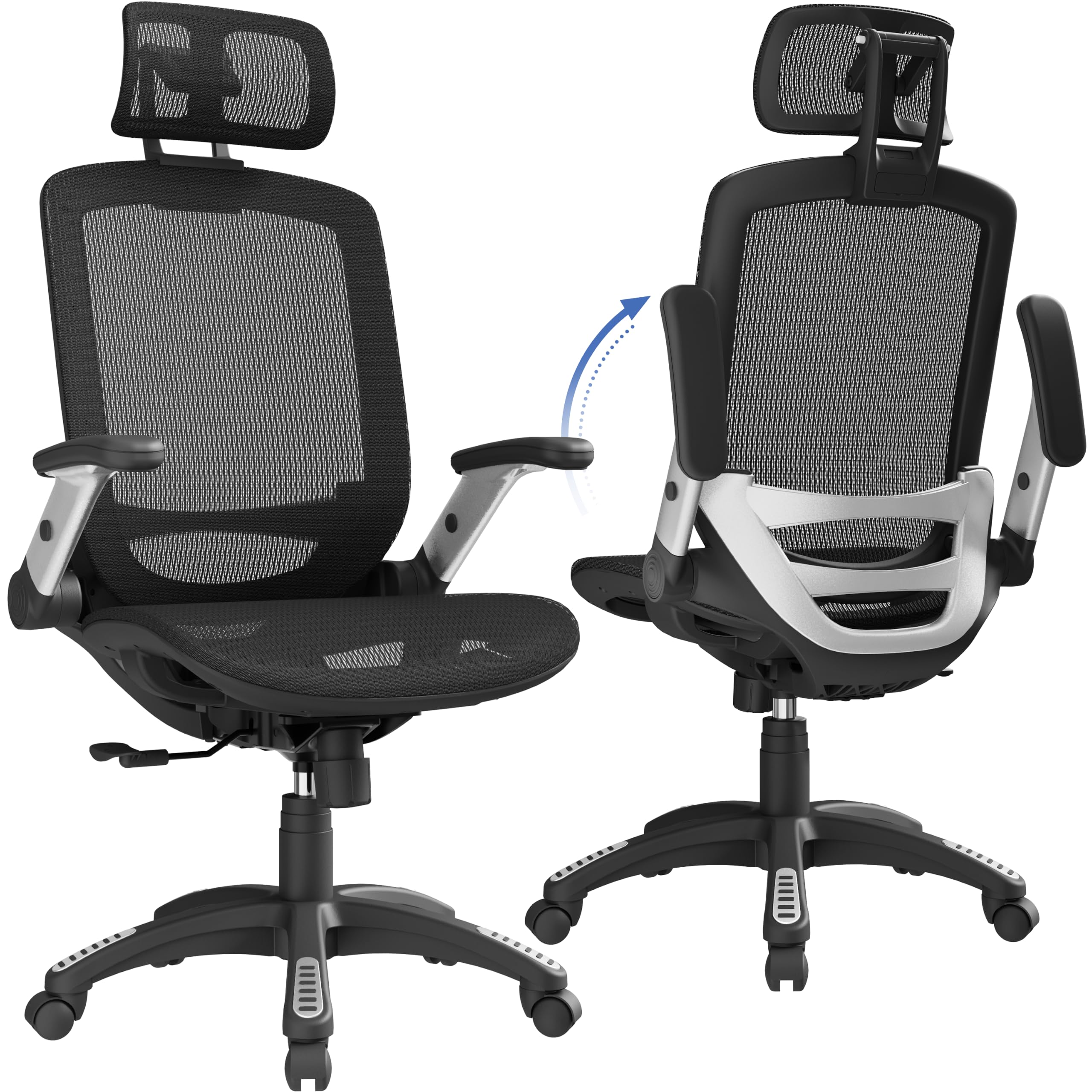
Students, researchers, and home study workers encounter a workspace constraint that corporate office employees rarely face: tight room geometry. In a bedroom, dorm room, or shared apartment study nook, desks are frequently compact, ranging from 40 to 48 inches wide with lower crossbars or keyboard drawers. When a standard office chair has fixed or rigid armrests, it cannot roll forward under the desk, consuming valuable floor area and forcing the user to lean forward over the edge of their seat.
The GABRYLLY Ergonomic Mesh Chair solves this workspace hurdle through its 90-degree folding flip-up armrest system. When you need elbow and forearm support during extended typing sessions, the padded arms rest securely in the horizontal position. When your study session ends, you simply press the pivot button and fold both arms upward into a vertical orientation. This allows you to roll the chair completely flush beneath any study desk, saving between four and six square feet of floor space and opening up cramped living quarters.
Beyond its space-saving engineering, the GABRYLLY features an all-mesh suspension design that circulates air across both the backrest and the seat pan. For university students pulling late-night exam prep or high school students studying for hours in warm bedrooms, the breathable double-layer polyester mesh prevents sweat accumulation and maintains a fresh microclimate.
The chair includes four distinct ergonomic support zones: an extra-wide curved mesh headrest that tilts and adjusts vertically by 1.8 inches, an integrated curved lumbar support arc, a waterfall mesh seat edge, and a recline mechanism that locks at 90, 105, and 120 degrees for relaxed reading.
Key Specifications
- Armrest Mechanism: 90-degree vertical flip-up folding armrests with soft PU padding
- Mesh System: High-elasticity double-layer breathable mesh across seat and back
- Headrest: 2D extra-wide curved mesh headrest with height (1.8") and angle (45°) tilt
- Recline Angles: 90°, 105°, and 120° locking positions with tilt tension control
- Recommended Height: Optimized for users between 5'2" and 6'2"
- Weight Capacity: 280 lbs
- Base: Heavy-duty five-star metal base with smooth PU dual casters
What We Liked
- Flip-up armrests allow complete tuck-in under compact student desks and small bedroom setups.
- Full mesh seat and back provide continuous cooling airflow during long study sessions.
- Wide curved headrest provides excellent cervical support when leaning back to read textbooks.
- Quick assembly process with clear instructions and pre-sorted hardware.
- Quiet polyurethane casters roll smoothly without scratching hardwood or laminate flooring.
Things to Consider
- Armrests cannot be adjusted horizontally (width) or slid forward and backward.
- Lumbar arch is fixed into the backrest frame shape rather than individually depth-adjustable.
- Mesh seat firmness may require an adjustment period for users accustomed to plush foam cushions.
5. COLAMY High-Back Executive Chair: Best Rotary Dial Adjustable Lumbar
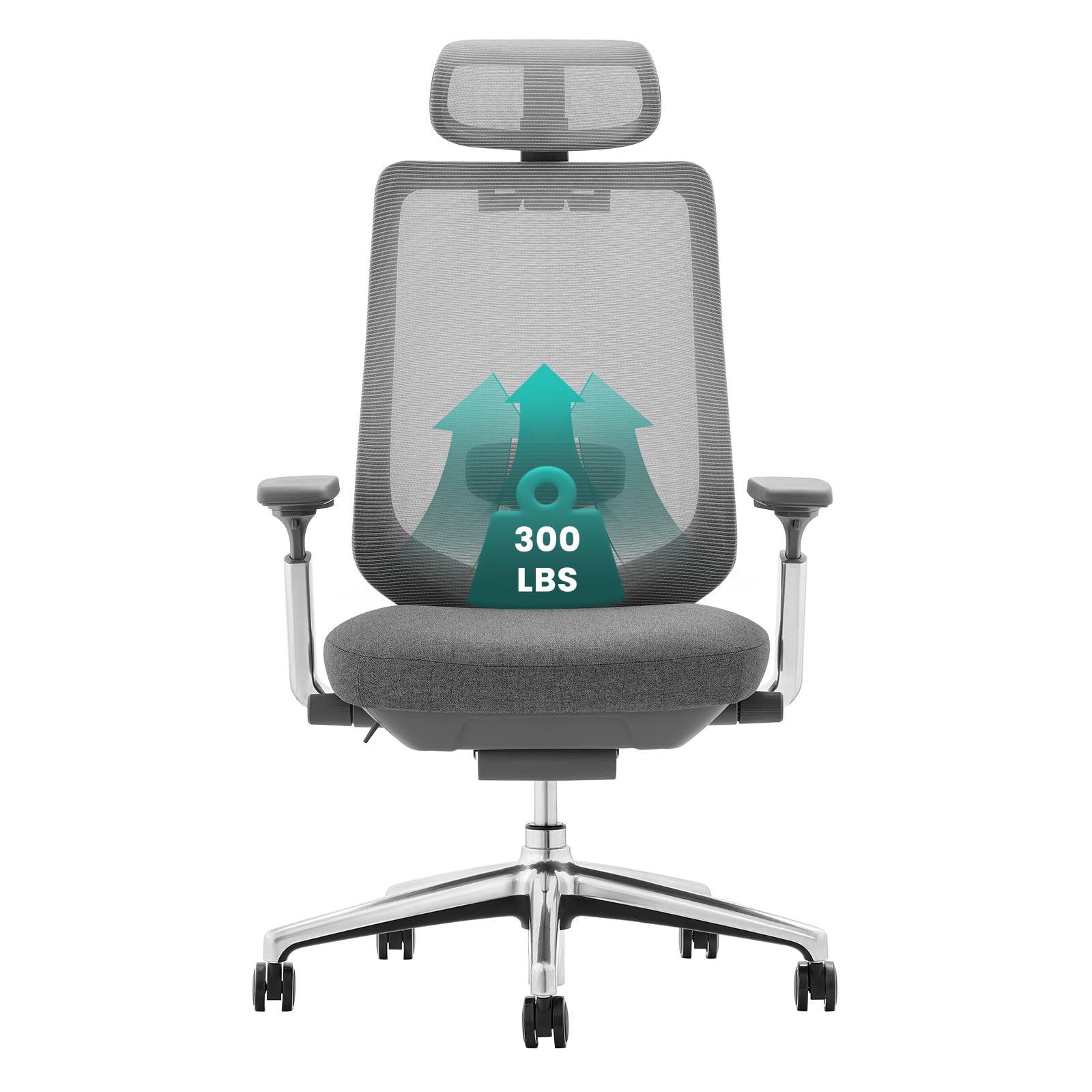
One of the most frequent complaints buyers have about ergonomic chairs is that the lumbar support is either too weak to provide real support or so aggressive that it feels like a hard brick digging into their kidneys. Every human spine possesses a unique depth of lordotic curvature; what feels perfectly supportive to a 6-foot, 200-pound worker can feel painful to a 5-foot-4, 130-pound user.
The COLAMY High-Back Executive Chair solves this fit challenge through its precision mechanical rotary dial lumbar adjustment system. Located on the side of the backrest frame, the dial operates an internal worm-gear drive that physically shifts the lumbar support pad forward or backward across a continuous depth range.
By rotating the dial clockwise, you can push the lumbar support forward to provide firm, pronounced anterior support that actively reinforces your lumbar lordosis during intensive typing. Rotating it counter-clockwise retracts the pad for a gentler, relaxed contour during reading or phone calls. In addition to depth adjustment, the entire lumbar assembly slides vertically by two inches, allowing you to position the apex of the support precisely against your L3 to L5 vertebrae.
The COLAMY chair pairs this mechanical lumbar control with a wide, high-back frame, a generously cushioned high-resilience foam seat with waterfall geometry, 3D adjustable armrests (height, depth, and pivot), and a polished aluminum alloy base that provides executive-level stability and a 300-pound load rating.
Key Specifications
- Lumbar System: Mechanical rotary dial for micro-depth adjustment plus 2-inch vertical slide
- Seat Cushion: High-resilience molded foam with premium breathable twill mesh upholstery
- Armrest Adjustability: 3D arms (height, forward-backward slide, internal/external angle pivot)
- Backrest Height: Full high-back profile with integrated adjustable headrest
- Recline Range: 90° to 130° with multi-position lock and heavy-duty tension knob
- Base Construction: Heavy-duty polished aluminum alloy 5-star base
- Pneumatics: SGS Class 4 explosion-proof gas lift cylinder
What We Liked
- Rotary dial allows precise customization of lumbar support pressure from subtle to deeply pronounced.
- High-back architecture and wide seat cushion accommodate broader shoulders and taller builds.
- Polished aluminum base and premium frame finish deliver an executive aesthetic.
- 3D armrests provide flexible positioning for keyboard typing, mouse navigation, and tablet reading.
- High-density molded foam cushion provides a supportive, durable seat that resists sagging.
Things to Consider
- The substantial high-back frame has a larger visual footprint in small study rooms.
- Heavier overall net weight (approximately 42 lbs) requires careful handling during assembly.
- Dial mechanism requires a few full rotations to travel between minimum and maximum depth.
6. Ollega Memory Foam Task Chair: Best Budget Cushion for Students & Dorms
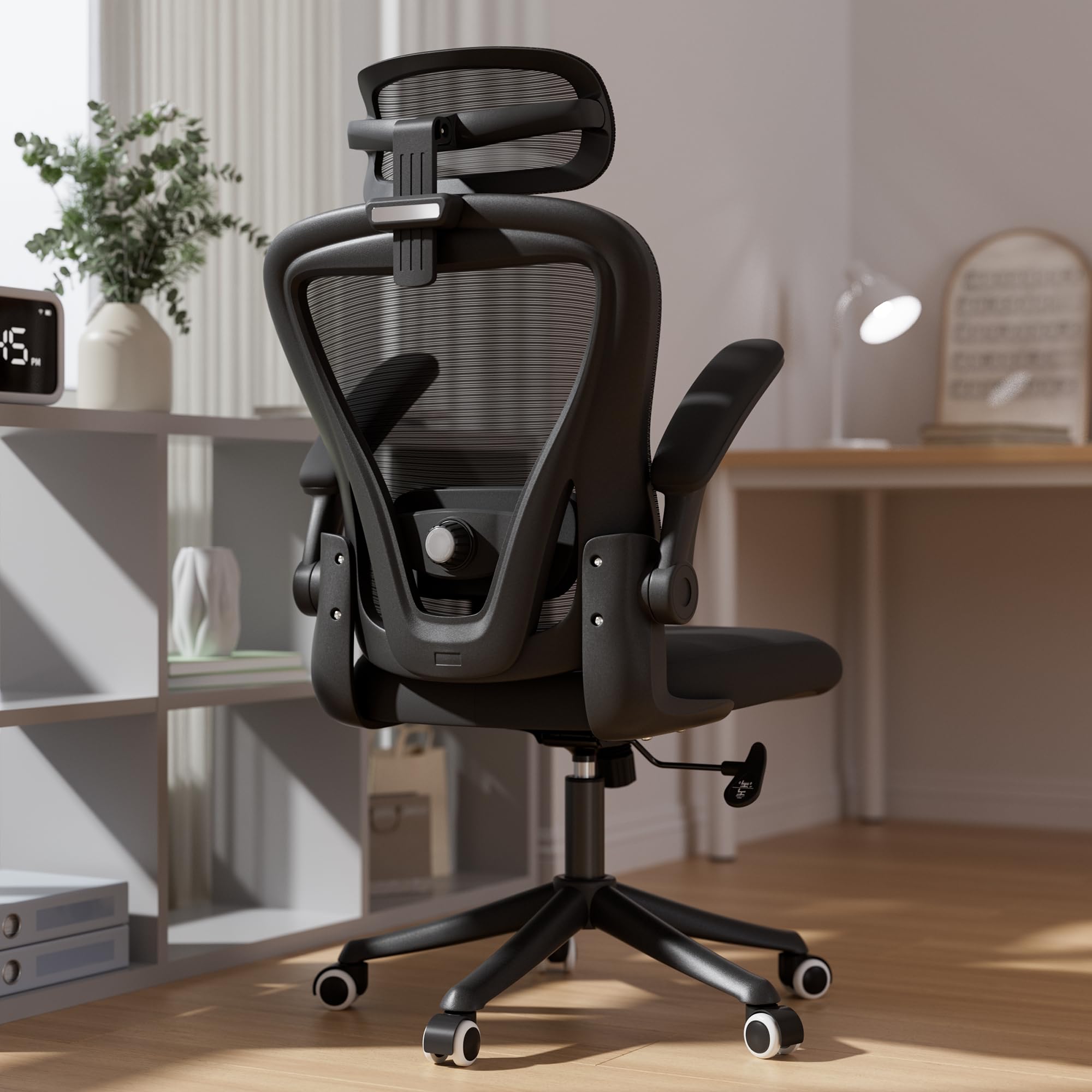
Not every desk user wants the firm, suspended sensation of an all-mesh chair. For students, writers, and remote workers who experience sharp sit-bone pain or tailbone tenderness when sitting on taut mesh or stiff commercial foam, a softer, adaptive seating cushion is essential. However, most budget foam chairs use cheap polyurethane cut foam that bottoms out to hard plastic within an hour of sitting.
The Ollega Memory Foam Task Chair addresses this comfort dilemma with a 3.5-inch multi-layer hybrid seat cushion. The top layer consists of high-density slow-rebound memory foam that molds to your pelvic contours, distributing body weight across a broader surface area and relieving localized pressure on the ischial tuberosities. Beneath the memory foam lies a firm, high-resilience base foam layer that prevents your pelvis from sinking down into the wooden seat pan foundation.
This dual-density cushion design is paired with an ergonomic mid-back breathable mesh backrest featuring built-in lumbar curvature. Like the GABRYLLY, the Ollega chair is engineered with 90-degree folding flip-up armrests. This feature is particularly valuable for college dormitories, shared student bedrooms, and compact apartment desks where preserving walkthrough space is a priority.
With a lightweight frame, smooth-gliding nylon casters, and a budget-friendly price point, the Ollega delivers practical ergonomic support and plush tailbone comfort without the bulky footprint of an executive chair.
Key Specifications
- Seat Cushion: 3.5-inch dual-density memory foam and high-resilience base foam
- Backrest: Breathable micro-mesh with integrated ergonomic lumbar arch
- Armrest System: 90-degree vertical flip-up armrests with padded fabric contact pads
- Recline Function: 15-degree gentle tilt rocking mechanism with tilt tension control
- Base: Heavy-duty nylon five-star base with 360-degree silent swivel casters
- Weight Capacity: 275 lbs
- Target User: Students, teen study desks, small home offices, apartment bedrooms
What We Liked
- Multi-layer memory foam cushion offers immediate, plush pressure relief for tender sit bones and tailbones.
- Flip-up armrests make it easy to push the chair flush under narrow writing tables and study desks.
- Compact footprint fits easily into tight dorm rooms and bedroom corners without overwhelming the room.
- Affordable price point accessible to students and budget-conscious home workers.
- Intuitive assembly takes less than twenty minutes with included hex tools.
Things to Consider
- Mid-back height does not provide upper shoulder or cervical headrest support.
- Tilt mechanism allows gentle rocking, but does not lock into multiple deep recline angles.
- Memory foam cushion retains body warmth longer than an all-mesh seating surface.
7. Marsail High-Back Ergonomic Chair: Best Recline & Tall User Frame
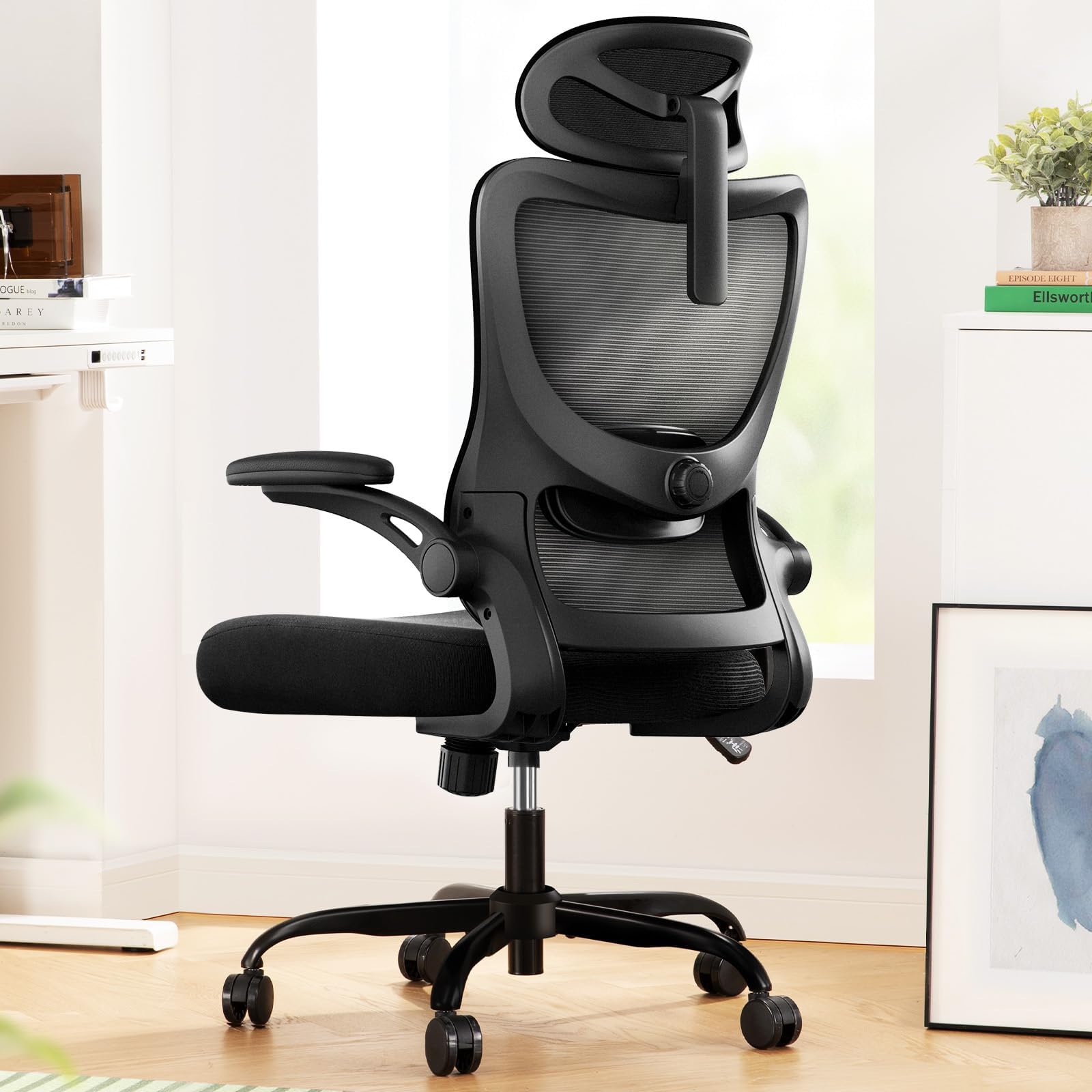
Taller individuals (5'11" to 6'4") face unique challenges when shopping for ergonomic chairs. On standard mid-back and compact chairs, the headrest digs painfully into their upper shoulder blades rather than cradling the neck, the backrest ends below their thoracic spine, and the seat depth leaves several inches of their thighs unsupported in mid-air.
The Marsail High-Back Ergonomic Chair is built with an extended backrest height and generous seating frame specifically proportioned for taller professionals and home workers who require full spinal coverage. The high-back frame extends all the way through the thoracic vertebrae to support the upper shoulders, topped by a large-format 2D headrest that adjusts vertically and pivots across a 45-degree angle to align naturally with the cervical curve of taller users.
To accommodate varying work styles throughout long desk days, the Marsail features a heavy-duty multi-angle recline mechanism that locks securely at 90 degrees for upright typing, 115 degrees for collaborative meetings and video calls, and 135 degrees for deep reading and rest breaks. Stowed seamlessly beneath the front of the seat pan is a pull-out padded footrest mounted on twin steel extension rails.
The chair incorporates an adaptive lower back support cushion that flexes with body movement, paired with a high-density molded foam seat that resists long-term compression. Silent polyurethane casters protect hardwood and tile floors while enabling smooth, friction-free movement across the workspace.
Key Specifications
- Frame Geometry: Extended high-back backrest engineered for users from 5'6" up to 6'4"
- Recline Capability: 90° to 135° multi-position lock mechanism
- Leg Rest: Retractable high-strength steel-rail padded footrest
- Cushion Composition: High-density molded foam with breathable fabric mesh cover
- Headrest: Large-surface 2D adjustable headrest with height and angle travel
- Pneumatics: SGS certified Class 4 heavy-duty steel cylinder
- Weight Capacity: 300 lbs
What We Liked
- Extended backrest height and headrest range provide genuine support for taller users.
- Smooth 135-degree recline with integrated footrest makes reading and breaks comfortable.
- Adaptive lower back support adjusts naturally as you lean back and change posture.
- Wide, comfortable seat pan accommodates broader leg stances without pinching outer thighs.
- Quiet, floor-safe polyurethane casters roll effortlessly across both wood and low-pile carpet.
Things to Consider
- Taller backrest and wide profile may overwhelm very compact study nooks.
- Shorter individuals (under 5'3") may find the seat pan depth too long for proper popliteal clearance.
- Armrests tilt with the backrest rather than offering independent 4D plane adjustments.
Chair Specifications & Feature Comparison
The table below compares published technical specifications, ergonomic adjustment mechanisms, upholstery materials, and recommended user profiles across all seven evaluated models:
| Model | Seat Material | Lumbar Type | Tilt Mechanism | Armrest Style | Capacity |
|---|---|---|---|---|---|
| Herman Miller Aeron | 8Z Pellicle Mesh | PostureFit SL (Sacral + Lumbar) | Kinematic Harmonic Tilt + Forward | Fully Adjustable 4D | 350 lbs |
| HON Ignition 2.0 | Molded High-Density Foam | Vertical Sliding Beam | Synchro-Tilt (2:1 ratio) + Slide | Height & Width Adjustable | 300 lbs |
| QLTPLUS Split-Backrest | High-Density Waterfall Foam | Dual-Wing Spring Split Lumbar | 90° to 135° Lock + Footrest | 3D Recline Linkage | 330 lbs |
| GABRYLLY Mesh Chair | Double-Layer Breathable Mesh | Integrated Ergonomic Arch | 3-Position Lock (up to 120°) | 90° Vertical Flip-Up | 280 lbs |
| COLAMY Executive | Molded Foam with Twill Mesh | Mechanical Rotary Dial Depth | Multi-Position Lock (up to 130°) | 3D (Height, Slide, Angle) | 300 lbs |
| Ollega Memory Foam | Dual-Layer Memory Foam | Contoured Mesh Arch | 15° Rocking with Tension Knob | 90° Vertical Flip-Up | 275 lbs |
| Marsail High-Back | Molded Foam Cushion | Adaptive Flexible Lumbar Pad | 90° to 135° Lock + Footrest | Recline Linked Arms | 300 lbs |
What to Look for When Choosing an Ergonomic Office Chair
Marketing materials in the office furniture category are filled with buzzwords like "orthopedic design" and "space-age comfort." To cut through sales hype, evaluate any chair against these five concrete biomechanical criteria:
1. Pelvic & Lumbar Support Architecture
A lumbar cushion that merely pushes your lower back forward without stabilizing the pelvis can actually increase spinal fatigue. Look for chairs that support the sacrum (the triangular bone at the base of the spine). When the sacrum is supported, the pelvis is physically prevented from rotating backward, allowing your lumbar lordosis to remain in its natural curve with minimal muscle strain. If you suffer from frequent lower back soreness, prioritize chairs with depth-adjustable lumbar pads (such as the COLAMY) or dynamic split-wing assemblies (such as the QLTPLUS) that adapt as your torso moves.
2. Seat Pan Depth & Popliteal Clearance
Seat depth is one of the most frequently overlooked dimensions. When you sit fully back against the backrest, there must be a two-to-three-finger clearance gap (approximately 1.5 to 2 inches) between the front edge of the seat cushion and the back of your knees (the popliteal fossa).
If the seat pan is too deep, the front edge will press directly into your calf tendons and popliteal nerves, restricting venous blood return to your lower legs, causing pins-and-needles numbness, and prompting you to slide forward away from the lumbar support. Chairs with sliding seat-glide mechanisms (like the HON Ignition 2.0) or sizing options (like the Herman Miller Aeron) eliminate this issue by matching your femur length.
3. Recline Mechanism & Synchro-Tilt Ratio
Sitting in a fixed 90-degree upright posture for eight hours places continuous static load on your discs. Modern ergonomic standards recommend a synchro-tilt mechanism with a 2:1 ratio. As you recline 20 degrees, the seat cushion tilts upward by only 10 degrees. This keeps your feet anchored flat on the floor, prevents the front seat edge from lifting your thighs, and opens your trunk-to-thigh angle to 105 or 110 degrees, which significantly reduces internal disc compression.
4. Armrest Functionality: 4D vs. Flip-Up Arms
Your arms account for roughly 10 percent of your total body weight. Without armrests supporting your forearms, that weight hangs directly from your trapezius and shoulder muscles, causing upper back knots and neck strain by mid-afternoon.
- 4D Adjustable Armrests: Adjust for height, width, forward-backward depth, and inward/outward pivot. They allow you to align armrests flush with your desk surface so your wrists stay straight while typing.
- 90-Degree Flip-Up Armrests: Ideal for compact study desks, student dorms, and multi-use bedrooms. They allow the chair to roll fully under the desk when not in use, reclaiming floor space and accommodating closer typing positions.
5. Upholstery Materials: Mesh vs. Molded Foam
- Elastomeric Mesh: Maximum airflow, no heat buildup, zero foam compression, firm responsive support. Unforgiving if your body contacts the composite perimeter frame.
- High-Density Molded Foam: Softer initial landing, superior pressure absorption across the sit bones, highly forgiving for varied sitting postures. Retains more body warmth in un-airconditioned rooms.
- Memory Foam: Molds closely to pelvic anatomy, relieving tailbone tenderness. Requires a dense base layer beneath it to prevent bottoming out.
5 Chair Red Flags & Designs to Avoid
When browsing office chairs online, steer clear of these five common design traps that often lead to buyers remorse and physical discomfort:
- Bucket-Style Racing Gaming Chairs with Side Wings: Bucket seats are engineered for lateral G-forces in race cars, not desk ergonomics. The sharp side bolsters on the seat pan squeeze your outer thighs together, preventing healthy leg abduction and restricting circulation during long work hours.
- Loose Elastic-Strap Lumbar Pillows: Cheap chairs often use a flat backrest bundled with a loose pillow held by elastic bands. These pillows constantly slip down into the seat gap, provide uneven support, and push your upper back away from the backrest.
- Cheap Bonded Polyurethane (PU) Leather: Bonded leather is made from shredded leather scraps glued with polyurethane. In warm rooms, it traps body heat and sweat, and within 12 to 24 months, the surface begins peeling and flaking onto your clothes and floor.
- Single-Lock Center-Tilt Rockers: Basic chairs feature a single lock pin that only secures at 90 degrees. When you lean back, the entire chair tilts from the center axle like a rocking horse, lifting your feet off the floor and placing excessive pressure under your thighs.
- Uncertified Class 1 or Class 2 Gas Cylinders: Budget chairs often cut manufacturing costs on the pneumatic piston. Low-tier cylinders are prone to leaking nitrogen gas within a few months, causing the chair to slowly sink to the floor every time you sit down. Always look for certified Class 3 or Class 4 cylinders tested to BIFMA standards.
The Ergonomic Workspace Blueprint: Desk, Monitor & Posture
Even the finest ergonomic chair cannot compensate for an improperly arranged desk. To achieve all-day comfort and prevent repetitive strain, arrange your workstation according to these ergonomic guidelines:
- Seat Height: Adjust cylinder height until your feet rest completely flat on the floor with knees bent at approximately 90 to 100 degrees. If your desk is non-adjustable and too high, raise the chair and use an ergonomic angled footrest.
- Armrest Alignment: Adjust armrest height so your elbows rest at a 90-degree angle with relaxed shoulders. Forearms should be parallel to the floor and level with your keyboard.
- Monitor Distance & Height: Position your display directly in front of you at arm's length (20 to 28 inches). The top third of the monitor screen should sit at or slightly below eye level, preventing you from craning your neck downward or tilting your head back.
- Laptop Ergonomics: Never work directly off a laptop on a flat desk for eight hours. Place the laptop on an elevated stand and connect an external keyboard and mouse so your screen remains at eye level.
- The 20-20-20 Movement Rule: Every 20 minutes, look at an object 20 feet away for 20 seconds to reduce ocular strain, and stand up or adjust your recline angle to encourage disc rehydration.
Which Ergonomic Chair Should You Choose?
To summarize our findings based on your primary daily activities, workspace size, and comfort priorities:
- For All-Day 8+ Hour Workdays: Choose the Herman Miller Aeron. Its 8Z Pellicle mesh suspension, dual-pad PostureFit SL sacral stabilization, and 12-year warranty make it the gold standard for full-time professionals.
- For Commercial Durability Under $500: Choose the HON Ignition 2.0. It balances a long-lasting contoured molded foam cushion with a breathable mesh back and a BIFMA-certified synchro-tilt mechanism.
- For Lower Back Pain, Sciatica & Rest: Choose the QLTPLUS Split-Backrest Chair. Its dual independent spring-loaded wings cradle your lumbar spine dynamically, and the 135-degree recline with footrest provides restorative breaks.
- For Compact Student Desks & Study Bedrooms: Choose the GABRYLLY Mesh Chair. Its 90-degree flip-up armrests allow it to roll flush under any study desk, while its full mesh frame keeps students cool.
- For Dial-Adjustable Lumbar Depth: Choose the COLAMY Executive Chair. Its mechanical rotary dial gives you millimeter-precise control over how firmly the lumbar pad presses against your lower back.
- For Tailbone Relief on a Budget: Choose the Ollega Memory Foam Task Chair. Its 3.5-inch multi-layer hybrid cushion cushions sensitive sit bones and fits seamlessly into dorm rooms and apartments.
- For Taller Users & Deep Recline: Choose the Marsail High-Back Chair. Its tall backrest frame, wide seat pan, and integrated footrest accommodate taller bodies comfortably.
Investing in an ergonomic chair tailored to your spinal needs and workspace geometry is one of the most effective decisions you can make for your everyday focus, physical comfort, and long-term musculoskeletal health.
Frequently Asked Questions
For prolonged sessions of eight to twelve hours, the Herman Miller Aeron remains the benchmark due to its elastomeric 8Z Pellicle mesh suspension and PostureFit SL sacral stabilization. Because the mesh distributes body weight across eight distinct tension zones without trapping heat, it prevents the pressure points and thermal buildup common to conventional foam seats. For buyers seeking a plush commercial-grade foam alternative at a mid-range price, the HON Ignition 2.0 provides exceptional endurance with its contoured molded cushion and synchro-tilt mechanism.

David Chen
Author, Office & Workspaces
David Chen covers ergonomic office chairs, standing desks, and desk setups. He focuses on long-term sitting comfort, build durability, and practical adjustments to help readers create better workspaces.