

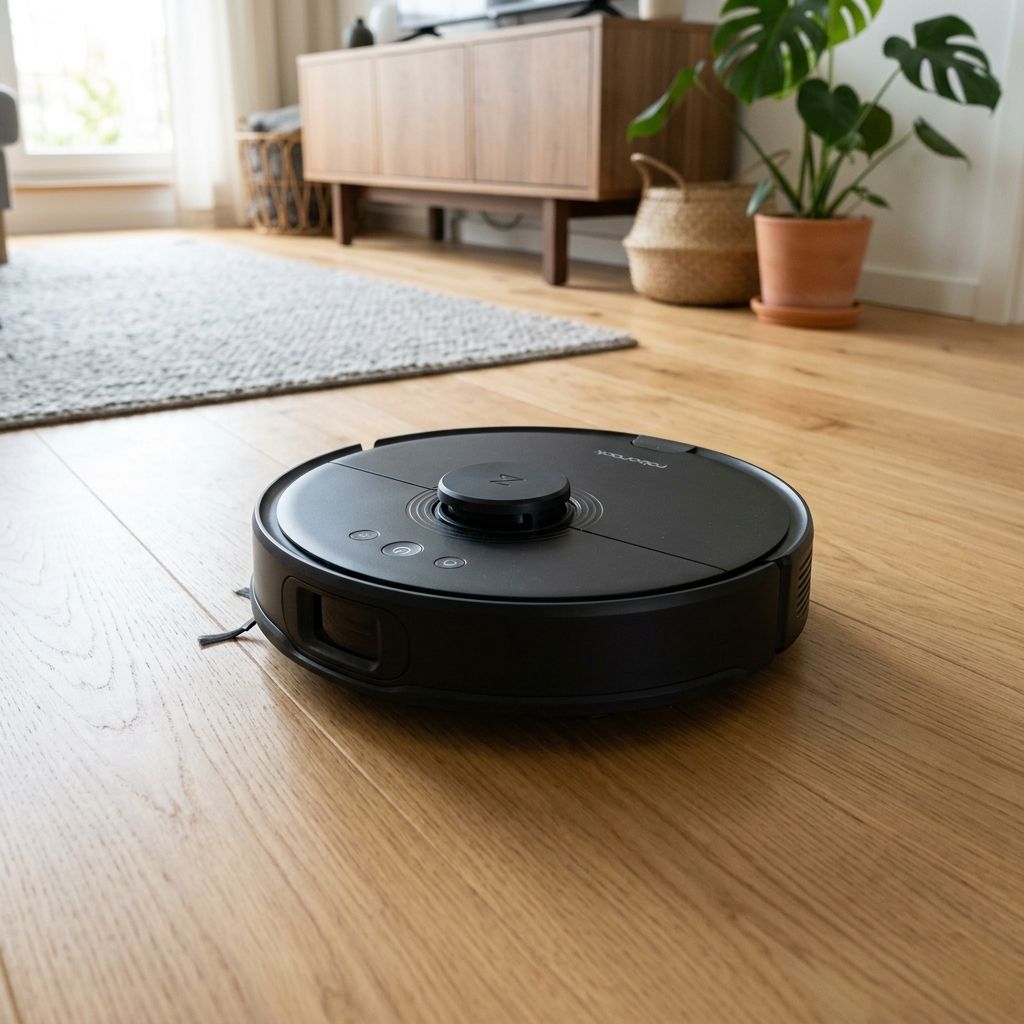
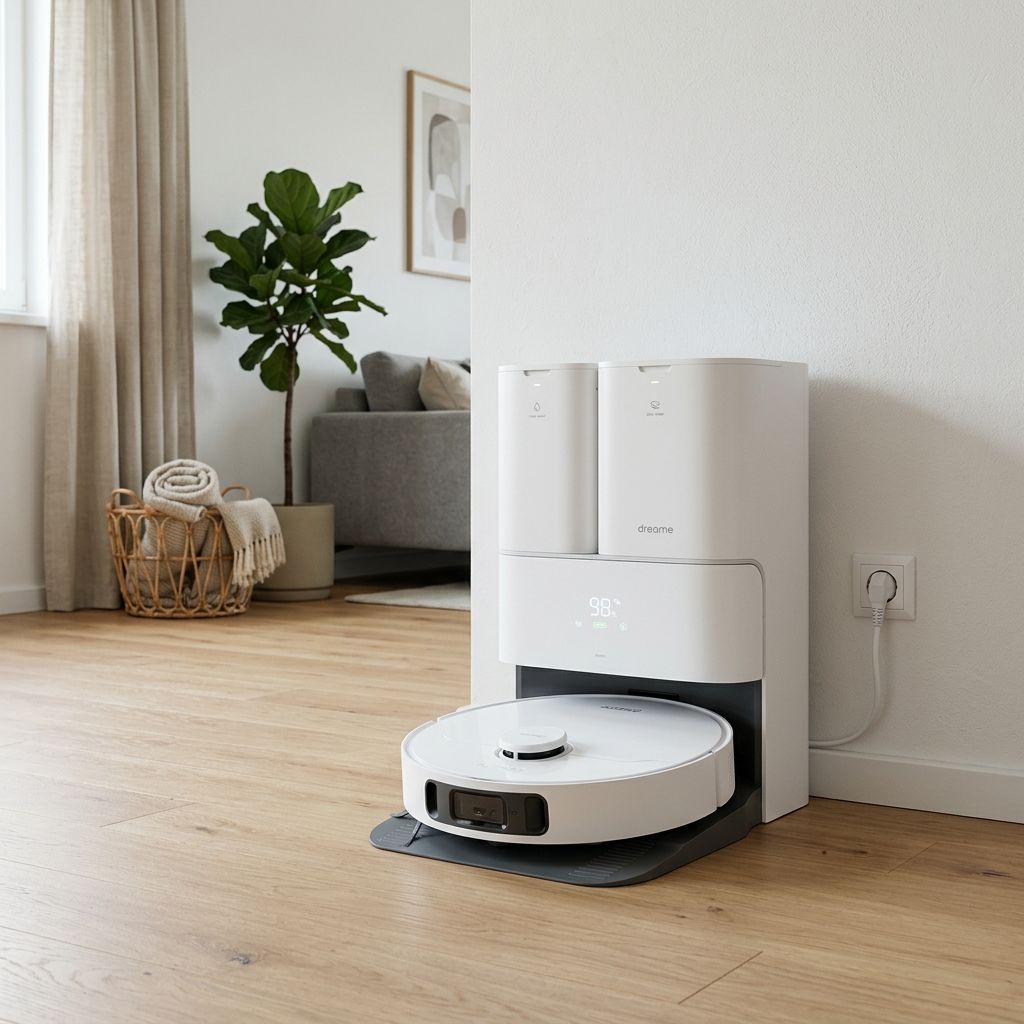
The Roborock and Dreame Rivalry: Engineering Approaches Compared
Over the past five years, the autonomous home cleaning industry transitioned from simple vacuum robots that bounced blindly off furniture into sophisticated robotic platforms capable of concurrent vacuuming, high-pressure mopping, optical hazard avoidance, and comprehensive dock-based sanitation. At the center of this premium segment stand two engineering heavyweights: Roborock and Dreame.
While both manufacturers originated within the broader consumer electronics hardware supply chain in Shenzhen and Beijing, their design philosophies have diverged into distinct mechanical paths. Roborock prioritizes high airflow velocity, dual counter-rotating rubber rollers, and dock self-maintenance features aimed at minimizing how often owners must physically scrub the base station. Dreame focuses on high mechanical articulation, pioneering motorized swing-out mop arms, active hair-cutting brush blades, and base stations that physically detach mop pads before entering high-pile carpet zones.
Choosing between a flagship Roborock cleaner (exemplified by the Roborock Qrevo Master and S8 series) and a flagship Dreame machine (exemplified by the Dreame L20 Ultra and X40 series) requires looking past marketing buzzwords. Beneath the surface, differences in brush roll mechanics, carpet defense clearance, obstacle vision architectures, recurring replacement part schedules, and six-month maintenance fatigue dictate which unit fits your home.
Roller Brush Architecture: Roborock DuoRoller vs. Dreame TriCut Cutting Blades
The mechanical interaction between a vacuum main roller and your flooring material determines cleaning yield far more than peak suction numbers. In standard residential environments, pet fur and long human hair present the most persistent challenge to robotic drivetrains.
1. Roborock DuoRoller: Dual Counter-Rotating Rubber Agitation
Roborock signature approach is the DuoRoller Riser assembly. Instead of relying on a single rotating brush with nylon bristles, Roborock uses two interlocking, counter-rotating solid rubber rollers that rotate in opposite directions toward the central suction intake.
- Carpet Agitation Mechanics: As the two rollers rotate inward, the raised rubber fins pinch and lift carpet fibers, agitating embedded sand, dander, and dried mud out of the carpet backing without relying entirely on motor vacuum pressure.
- Hair Wrap Resistance: Because the rollers lack traditional nylon bristles, human and pet hair cannot easily weave into fiber tufts. Instead, hair slides along the smooth rubber surface toward the outer roller axles.
- The Hidden Axle Bearing Weakness: While the center span of the DuoRoller stays remarkably clean, hair strands migrate outward into the internal axle bearings. If left unserviced for two to three weeks, hair wraps tightly around the steel drive pin, generating heat from friction that can degrade the rubber end cap and place increased load on the drive motor. Roborock addresses this by making both end caps easily removable without tools for routine clearance.
2. Dreame TriCut Brush: Recessed Micro-Blades
Dreame standard configurations use a hybrid rubber and bristle roller, but their flagship innovation is the TriCut Anti-Tangle Brush (available standard on high-end models or as a modular upgrade).
- Cutting Architecture: The TriCut roller integrates tiny, recessed precision steel blades enclosed inside protective plastic comb guards. As hair wraps around the roller during a cleaning cycle, the rotation forces strands against the comb slots where the oscillating blades cut the hair into short 15 mm to 20 mm fragments.
- Suction Clearance: Once sliced, the hair fragments lose their structural tension and are drawn immediately into the suction channel and dustbin, preventing axle tangles.
- Safety and Durability Trade-offs: The cutting blades are fully shielded to prevent carpet fiber fraying or skin contact during manual handling. However, the TriCut assembly contains moving mechanical linkages that require replacement every 6 to 9 months, costing approximately $45 to $55 per replacement assembly compared to $25 for a standard rubber roller set.
Mopping Systems: Dual Spinning Discs vs. Robotic Arm Edge Extensions
Both Roborock (on the Qrevo line) and Dreame (on the L and X series) utilize dual circular spinning mop pads that rotate at 180 to 200 RPM while exerting continuous downward pressure against hard floors. This spinning action delivers superior stain removal compared to older static drag-cloths or basic sonic vibration plates when tackling sticky kitchen spills, dried coffee droplets, and muddy paw prints.
Edge and Baseboard Coverage: FlexiArm vs. MopExtend
Historically, the circular footprint of robot vacuums created an unavoidable physical limitation: because circular mop pads sit within the chassis perimeter, the robot left an unwashed perimeter gap of 1.5 to 2 inches along baseboards, cabinet toe-kicks, and around chair legs.
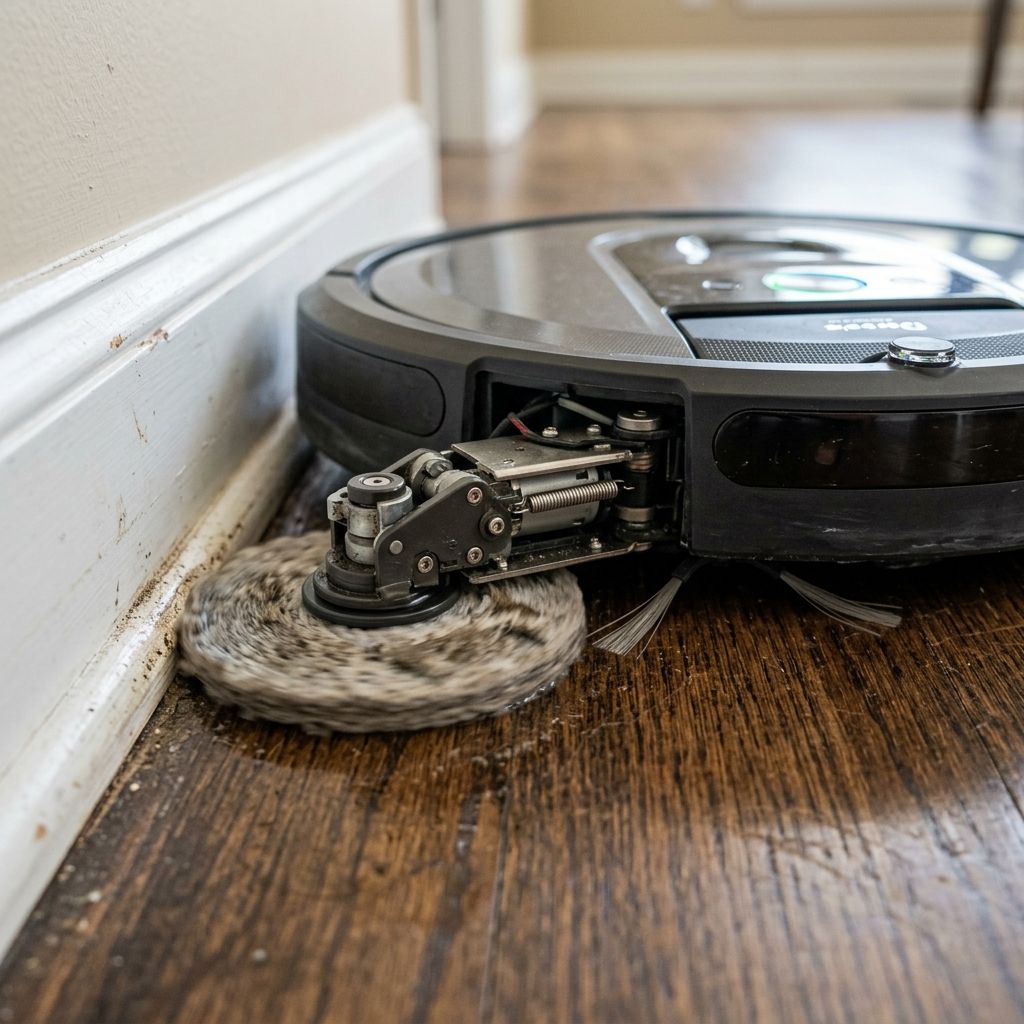
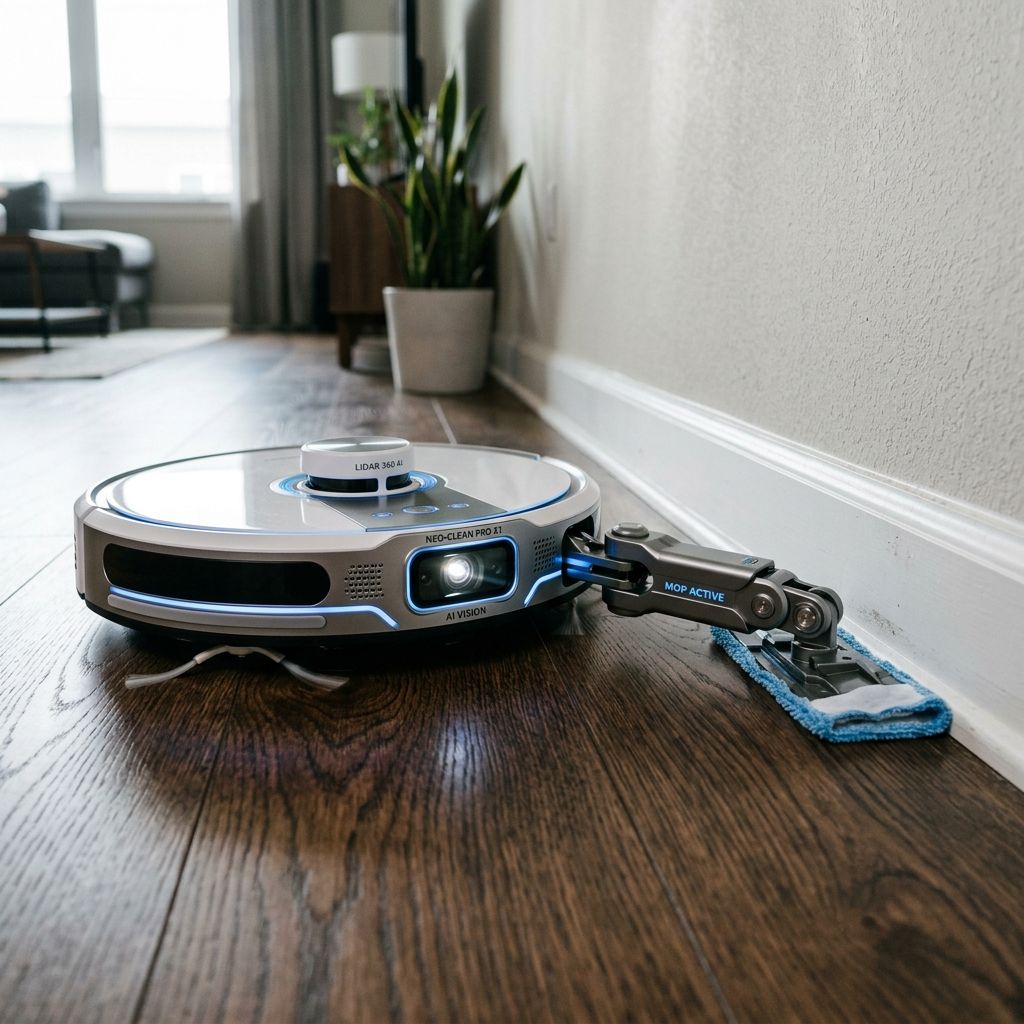
- Dreame MopExtend: Dreame was the first to introduce a bionic mechanical swing arm. When the robot LiDAR and side wall-following sensors detect a baseboard, door threshold, or irregular furniture leg, an internal actuator extends the right spinning mop pad outward past the robot chassis boundary. This allows the spinning pad to scrub flush within 2 millimeters of walls and reach under low-clearance cabinet recesses.
- Roborock FlexiArm: Roborock matched this capability with its FlexiArm technology on the Qrevo Master and S8 MaxV Ultra. Roborock extended this articulation to both the right mopping disc and the side sweeping brush, allowing the side brush to reach outward into 90-degree internal room corners where round vacuum chassis cannot reach.
- Practical Edge Result: Both systems dramatically reduce manual Swiffer or damp-mop touchups along baseboards. In homes with extensive cabinetry and intricate table legs, Dreame extension algorithm reacts slightly faster along curved contours, whereas Roborock dual-articulating side brush provides cleaner corner dust extraction.
Carpet Protection Dynamics: Mop Lifting (10mm) vs. Base Station Magnetic Detachment
The single most common complaint regarding 2-in-1 robot vacuum-mop hybrids centers on wet carpets. When a hybrid robot finishes mopping a kitchen or hallway tile and traverses an area rug to reach the living room, how does it prevent dragging a wet, dirty mop across carpet fibers?
1. Roborock Motorized Mop Lift (10 mm)
Roborock equips its cleaning head with an ultrasonic carpet detection sensor positioned ahead of the front caster wheel. The instant high-frequency acoustic waves encounter carpet pile, an internal stepper motor lifts the spinning mop plates 10 millimeters above the floor, while simultaneously cutting liquid delivery from the onboard reservoir and boosting motor suction.
- Where It Succeeds: On hard surfaces, low-pile commercial rugs, and flat-woven entry mats, a 10 mm lift clearance is fully sufficient to keep damp microfibers from touching the carpet surface.
- Where It Fails: On medium-pile, plush, or shag carpeting with pile heights exceeding 0.4 inches (10 mm), the robot wheels sink slightly into the soft carpet underlayment. Even with the mop plates lifted to their maximum height, the wet microfibers brush across the tips of the carpet yarn, transferring residual moisture and floor grime.
2. Dreame Magnetic Auto-Mop Detachment
To eliminate the carpet-wetting limitation entirely, Dreame engineered Mop Pad Auto-Detachment on the L20 Ultra and subsequent models.
- How It Operates: In the Dreamehome application, users can configure a specialized carpet strategy: "Mop After Vacuum" or "Detach Mops on Carpet Runs". When a scheduled cleaning includes carpeted rooms, the robot docks at the base station first. The dock activates magnetic retaining clips that hold the two circular mop discs in the base while the robot backs out, leaving the damp pads behind.
- True Dry Carpet Vacuuming: With the mop assemblies completely detached, the robot navigates onto high-pile rugs, wool carpets, and plush bedroom flooring with zero risk of moisture transfer. Once carpet vacuuming completes, the robot returns to the dock, re-attaches the magnetic mop pads in under 15 seconds, and resumes mopping hard floors.
- The Trade-off: This process adds extra transit cycles to each cleaning run, increasing total run times by 10 to 18 minutes depending on floor plan layout.
Robot Vacuum with Mop vs. Vacuum-Only: Do You Actually Need a Wet Tank?
Before spending between $800 and $1,500 on an all-in-one vacuum and mopping system, prospective buyers must evaluate whether their household layout justifies the operational overhead of a wet cleaning system.
The Hidden Realities of Onboard Mopping Systems
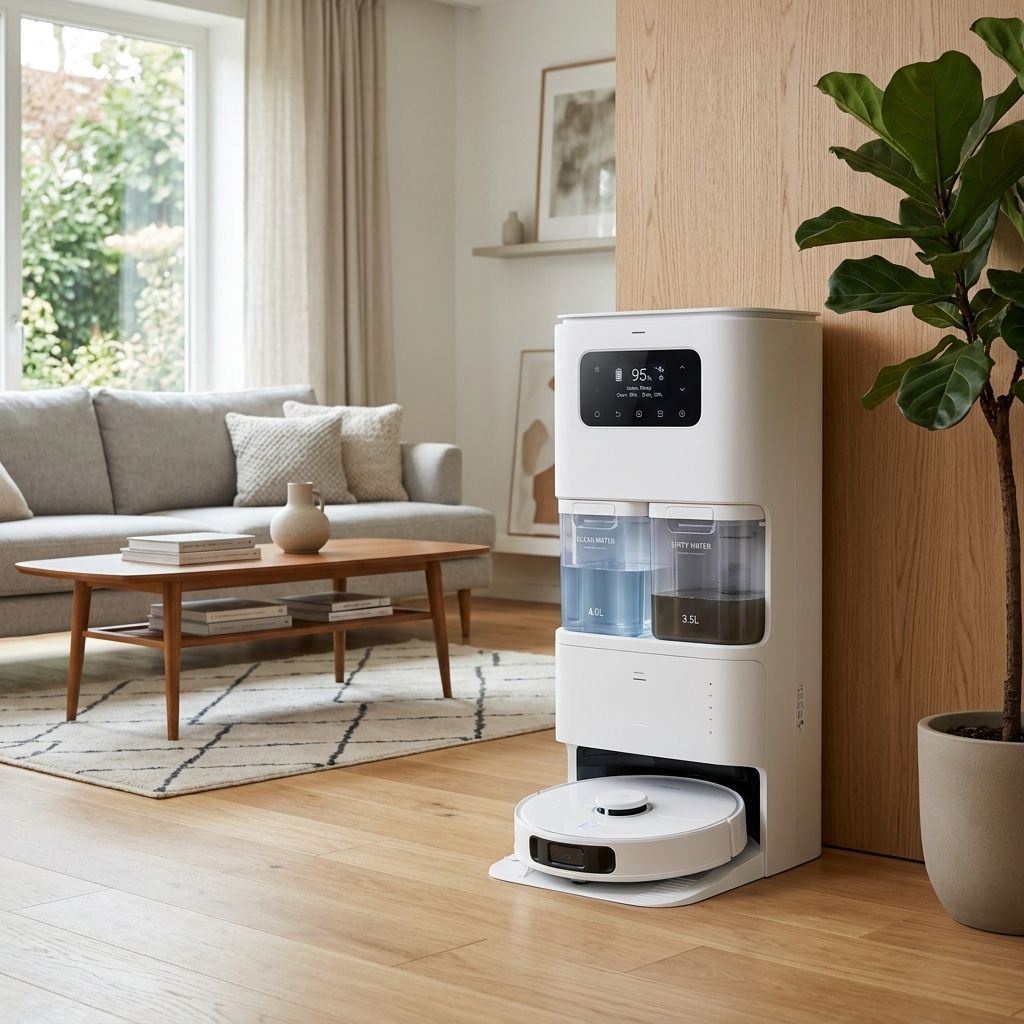
- The Stagnant Dirty Water Risk: The moment a robot scrubs hard floors, the collected liquid transfers into the dock dirty water reservoir. If this wastewater sits sealed at room temperature for more than 48 to 72 hours, anaerobic bacteria multiply rapidly, generating a sour, sewer-like odor that escapes into the room whenever the dock ventilates. Homes using hybrid mopping docks must commit to emptying and rinsing the dirty water tank at least twice weekly.
- Dock Sludge Accumulation: Washing dirty mop pads at the dock leaves behind sediment, fine sand, and pet hair in the washboard drainage tray. Over two to three weeks, this residue forms a sticky biofilm sludge that clogs the dock water intake filter unless scrubbed manually with a small brush.
- Flooring Ratio Considerations: If your residence is composed of 70 percent or more wall-to-wall carpeting, the mopping module will remain disengaged or parked in the dock during the vast majority of cleaning runs.
When a Vacuum-Only Model Is the Smarter Choice
If your living space features predominantly carpeted rooms, or if you prefer to wash hard floors manually with a traditional steam mop every few weeks, dedicated vacuum-only models (such as an iRobot Roomba j7+, Roborock Q5 Pro+, or Shark AI Vacuum) offer compelling advantages:
- Lower Initial Investment: High-performance self-emptying vacuum-only units typically retail between $350 and $600, saving $500 to $900 compared to full-featured mop docks.
- Zero Liquid Maintenance: No water tanks to fill, no dirty water reservoirs to deodorize, and zero risk of dock drainage tray overflows or pump failures.
- Compact Dock Footprint: Dust-only self-emptying docks occupy less than half the vertical height and horizontal volume of dual-tank mopping base stations.
Self-Emptying Docks vs. Standard Manual Bins: Noise, Footprint, and Consumables
Automated self-emptying docking stations have transformed robotic cleaning from a daily chore into a hands-off weekly routine. However, they introduce physical and environmental compromises that manufacturers rarely emphasize.
1. Acoustic Noise Spikes During Evacuation
While modern robot vacuums operate at quiet sound levels between 58 and 65 dBA while cleaning, the docking station evacuation cycle operates on a fundamentally different scale. To pull compressed pet hair and fine dander out of the robot internal dustbin through a narrow rubber intake duct, the base station engages a high-powered 1,000-watt suction motor.
For 15 to 25 seconds, the base produces an acoustic blast measuring 78 to 82 dBA, equivalent to a commercial food blender or loud upright vacuum running at point-blank range. If your docking station resides in a bedroom, living room, or nursery, scheduled cleaning runs during nighttime or early morning hours can cause sudden disruptions. Both the Roborock and Dreame companion apps include customizable "Do Not Disturb" (DND) modes that suppress automatic evacuation during scheduled quiet hours, deferring dustbin emptying until daytime.
2. Physical Floor Space and Clearance Demands
Flagship all-in-one stations from both Roborock and Dreame are substantial appliances. A typical station measures approximately 17 to 20 inches wide, 18 to 22 inches deep, and 23 to 25 inches tall. Furthermore, the optical homing beacons and infrared docking transponders require at least 1.5 feet of open, unobstructed clearance on both sides of the base, and at least 4 feet of forward line-of-sight clearance into the room.
Attempting to tuck the docking station into a narrow hallway alcove, between tight kitchen cabinets, or behind open doors frequently causes homing signal reflections that prevent the robot from docking cleanly after cleaning runs.
3. Sealed Bags vs. Allergen Protection
Both Roborock and Dreame utilize disposable multi-layer synthetic dust bags (2.7 liters on Roborock, 3.2 liters on Dreame) equipped with sliding plastic collar seals. When the bag reaches capacity after 6 to 9 weeks of daily use, pulling the collar automatically slides a cardboard or plastic shutter shut, trapping captured dust mites, pollen, and pet dander inside.
For individuals suffering from asthma or dust-mite allergies, this sealed mechanism eliminates the plume of airborne dust caused by manually tapping a small robot dustbin over an open kitchen trash can.
Robot Vacuums for Pet Hair vs. Regular Upright and Cordless Vacuums
A frequent misconception among prospective buyers is that purchasing a flagship $1,400 robot vacuum will allow them to discard their traditional upright or cordless stick vacuum. In reality, robotic cleaners and manual vacuums operate under completely different fluid-dynamic principles.
Airflow Velocity: The CFM Reality
Suction capability in vacuum systems is governed by two interrelated metrics: static suction pressure (measured in Pascals, Pa) and airflow volume (measured in Cubic Feet per Minute, CFM).
- Robot Vacuum Airflow: Due to miniature 14.4V battery architectures and compact internal blower turbines, even the most powerful robot vacuums generate between 15 and 28 CFM of airflow. High Pascal ratings (7,000 Pa to 10,000 Pa) indicate concentrated static pull at a narrow orifice, but total air volume through the cleaning head remains modest.
- Corded Upright / Cordless Stick Airflow: A standard corded upright vacuum (such as a Shark Navigator or Dyson Ball) draws power directly from a 120V wall outlet, spinning full-scale dual-cyclonic turbines that generate between 65 and 110 CFM of airflow, paired with wide, heavy beater bars powered by dedicated 100-watt roller motors.
The Daily Maintenance vs. Deep Extraction Distinction
Because a robot vacuum runs automatically every single day while you are at work or away from home, it intercepts shedding pet hair, loose dust bunnies, and surface crumbs before they become embedded into carpet fibers or ground into hardwood seams. By suppressing daily surface accumulation, your floors look consistently tidy.
However, a robot vacuum cannot agitate deep sand, fine pulverized soil, or ground-in dander trapped at the base of plush carpet backing. Nor can a robot vacuum clean sofa cushions, car interiors, carpeted stair treads, mattress seams, or ceiling corners. Consequently, an autonomous vacuum functions as a daily maintenance tool that dramatically reduces manual vacuuming frequency from two to three times per week down to once or twice per month, but cannot entirely replace a high-airflow manual vacuum.
Obstacle Avoidance in the Real World: Structured Light, RGB Cameras, and Household Hazards
Top-mounted LiDAR laser turrets excel at constructing room geometry, mapping walls, and navigating through doorways in total darkness. However, LiDAR rotates on a horizontal plane approximately 3.5 inches above floor level, rendering it completely blind to low-profile hazards sitting directly on the floor.
To prevent robots from ingesting charging cables, tangling in shoelaces, or dragging pet accidents across living room floors, both Roborock and Dreame integrate secondary front-facing optical sensor arrays.
1. Sensor Hardware Comparison
- Roborock Reactive AI: Utilizes a front-facing structured 3D light projector paired with an RGB color camera and infrared auxiliary sensors. The structured light array projects vertical infrared patterns across the floor to detect object contours down to 10 millimeters in height, while the RGB camera feeds an on-device neural network trained to recognize shoes, pet bowls, cords, and waste.
- Dreame AI Action: Combines dual structured 3D laser cross-projectors with an AI RGB video camera, complemented by dual front-facing automatic LED headlights.
2. The Low-Light and Night Cleaning Advantage
The inclusion of physical LED headlights on the Dreame L20 Ultra gives it a distinct advantage in real-world homes. Many homeowners schedule robot vacuuming to run overnight while the family sleeps. In pitch-black rooms, standard RGB cameras lose color contrast and edge fidelity, forcing the robot to rely solely on structured light contouring.
When the Dreame robot enters an unlit hallway or dark bedroom, its optical sensors detect low ambient lux levels and automatically illuminate its twin LED headlights. This provides bright, clear illumination for its RGB object recognition pipeline, allowing it to identify and avoid thin black phone charging cables and rogue socks in total darkness where unilluminated vision systems struggle.
3. The Dark Rug Cliff Sensor Dilemma
All modern robot vacuums incorporate four to six downward-facing infrared cliff sensors along their front bumper perimeter to prevent tumbling down stairwells. When infrared light emits from the sensor, it bounces off the floor and returns to a receiver diode. If no light returns, the robot assumes it has encountered open air and immediately halts and reverses.
A notorious side effect of this safety mechanism occurs when robots encounter dark-colored, charcoal, or deep black area rugs. The dark pigment in the carpet fibers absorbs the infrared light beam rather than reflecting it back to the sensor. The robot interprets the black pattern as an open stairwell, causing it to stutter, throw an error code, or refuse to clean the rug.
Both Roborock and Dreame have developed software filtering algorithms to distinguish dark rug textures from true vertical drop-offs, but homes with high-contrast geometric black-and-white rugs should verify that companion apps allow disabling cliff sensors or creating custom floor texture overrides for specific rooms.
Annual Maintenance Costs and Replacement Parts: The True Recurring Budget
Purchasing a premium robotic vacuum involves recurring operational expenses that should be factored into your long-term household budget. Consumable components experience friction, abrasive wear, and filter pore saturation, necessitating routine replacement to sustain peak airflow and sanitary mop washing.
Consumable Replacement Schedule and Pricing
| Component | Replacement Frequency | Roborock Annual Cost | Dreame Annual Cost |
|---|---|---|---|
| Dust Collection Bags (Dock) | Every 6 to 8 weeks (6 to 8 bags/yr) | $22 to $30 (6-pack) | $24 to $32 (6-pack) |
| HEPA Air Filters (Robot Bin) | Every 3 to 6 months (3 to 4 filters/yr) | $18 to $26 (4-pack) | $20 to $28 (4-pack) |
| Main Roller Assembly | Every 6 to 12 months | $24 (DuoRoller 2-piece set) | $22 (Std) / $48 (TriCut) |
| Spinning Mop Microfiber Pads | Every 3 to 6 months (2 to 3 sets/yr) | $16 to $22 (4-pack) | $18 to $24 (4-pack) |
| Side Sweeping Brushes | Every 6 to 12 months | $12 (2-pack) | $10 (2-pack) |
| Estimated Annual Total | Standard usage cycle | $92 to $110 per year | $94 to $142 per year |
Over a typical three-to-four-year hardware ownership lifespan, expect to invest approximately $300 to $500 in replacement dust bags, filters, mop pads, and roller brushes to maintain optimal suction velocity and sanitary floor cleaning.
Durability and Performance Degradation After 6 to 12 Months of Daily Operation
While new robot vacuums operate smoothly straight out of the box, mechanical degradation sets in after hundreds of operating hours if maintenance routines are neglected. Based on engineering teardowns and aggregated community owner reports, several predictable friction points emerge across both brands.
1. Dock Washboard Sludge and Drain Basin Clogs
The most maintenance-intensive component on any all-in-one docking station is the bottom washboard tray where wet mop pads are scrubbed. During washing, water sprays onto the pads while the tray ribs scrape away grime. The resulting dirty water drains through a small mesh filter into an internal suction sump that pumps it up into the dirty water tank.
- The Degradation: Fine household dust mixed with pet hair and dried floor detergent forms a thick, gelatinous sludge that settles in the bottom corners of the tray. After 4 to 8 weeks, this sludge blocks the drainage mesh, causing wastewater to back up into the tray until the dock triggers an error and halts mid-cycle.
- Roborock Advantage: On the Qrevo Master and S8 MaxV Ultra, Roborock introduced motorized self-cleaning scrapers that rotate along the tray floor, continuously pushing sediment toward the drainage port. While the tray still requires manual rinsing every 4 to 6 weeks, it clogs far less frequently than static washboards.
- Dreame Maintenance: The Dreame L20 Ultra washboard tray is completely removable with a single latch, making it easy to carry to a utility sink for a quick rinse and scrub under warm running water.
2. Fine Dust Turbine Bypass and Filter Saturation
Robot vacuum internal HEPA filters capture fine pet dander and microscopic dust particles down to 0.3 microns. As the filter pleats fill with fine debris, airflow resistance increases exponentially.
Many owners attempt to wash their pleated filters with tap water and reinstall them before they are 100 percent dry. Installing a damp filter creates two severe problems: residual moisture causes fine dust to cake into a solid cement-like crust across the filter mesh, permanently cutting airflow by up to 50 percent; additionally, damp air entering the high-speed brushless turbine motor can cause bearing oxidation and premature motor whine. Filters should only be rinsed if permitted by the manufacturer, and must cure in open dry air for at least 24 hours prior to reinstallation.
3. Wheel Traction Wear on Smooth Surfaces
Both robots feature spring-loaded drive wheels wrapped in synthetic rubber tread designed to climb 20 mm door thresholds and grip slick tile. Over 12 to 18 months of operating on textured stone tile or gritty hardwood, the rubber tread ribs gradually smooth down. On homes with glazed ceramic tile or wet bathroom thresholds, worn drive tires can lose traction, causing the robot to spin its wheels in place, disorient its dead-reckoning positioning, and report false wheel-jam error codes.
Clear Decision Framework: Which Brand Should You Choose?
Choose Roborock if:
- Your home features mixed flooring with significant carpet area: The DuoRoller counter-rotating rubber brush system delivers superior mechanical agitation on low-to-medium pile carpets compared to single-roller configurations.
- You want minimum dock maintenance effort: Roborock heated 140°F (60°C) water wash and self-cleaning motorized scraper tray keep the base station sanitary with noticeably less manual sludge buildup.
- You prioritize corner dust collection: The FlexiArm articulating side sweeping brush reaches into tight 90-degree room corners where fixed brushes cannot sweep.
- You prefer a proven, rock-solid companion app: The Roborock application delivers immediate map loading, responsive multi-floor management, and granular room-by-room sequencing.
Choose Dreame if:
- Your home has plush, medium-to-high pile rugs: Dreame magnetic auto-mop detachment leaves wet mop pads behind at the dock, completely eliminating the risk of dampening expensive wool or high-pile carpeting.
- You frequently run scheduled cleanings at night: Dual front-facing automatic LED headlights illuminate dark rooms, preserving full AI RGB obstacle recognition and cable avoidance in zero ambient light.
- You want superior edge-to-baseboard mopping: The MopExtend bionic robotic arm articulates outward seamlessly along baseboards, cabinet toe-kicks, and around curved chair legs.
- Long human or pet hair is your primary frustration: Upgrading to the Dreame TriCut brush roller actively severs hair strands into short fragments, virtually eliminating hair-wrapping on the main roller core.
The Bottom Line
Both Roborock and Dreame represent the pinnacle of automated residential floor care. In direct engineering capabilities, the Roborock Qrevo Master earns our top overall recommendation for most homes due to its superior dual-roller carpet agitation, 10,000 Pa suction ceiling, 140°F heated water wash, and lower dock cleaning overhead.
However, for households with expensive plush carpets where even a 10 mm mop lift poses a moisture risk, or homes where overnight cleaning in total darkness is standard, the Dreame L20 Ultra provides unique mechanical solutions with its magnetic mop detachment and dual LED headlights that no conventional robot vacuum can match.