

The Kitchen Countertop Dilemma: Why Basket Arrangement Matters
Over the past five years, dual-basket air fryers have taken over family kitchens for one simple reason: they eliminated the dinner timing headache. Instead of cooking salmon in an air fryer while roasted potatoes turn cold and soggy on a cutting board, dual-basket machines allow you to cook proteins and sides in two thermally independent chambers that finish at the exact same second.
However, the runaway best-seller in this space, the Ninja Foodi DualZone XL (DZ401), brought a major kitchen compromise into homes: its massive footprint. Measuring over 17 inches wide, the DZ401 occupies a huge swath of horizontal counter space. In compact apartments, urban condos, and older homes with limited counter runs, parking the DZ401 next to a coffee machine and a cutting board effectively wiped out all food prep real estate.
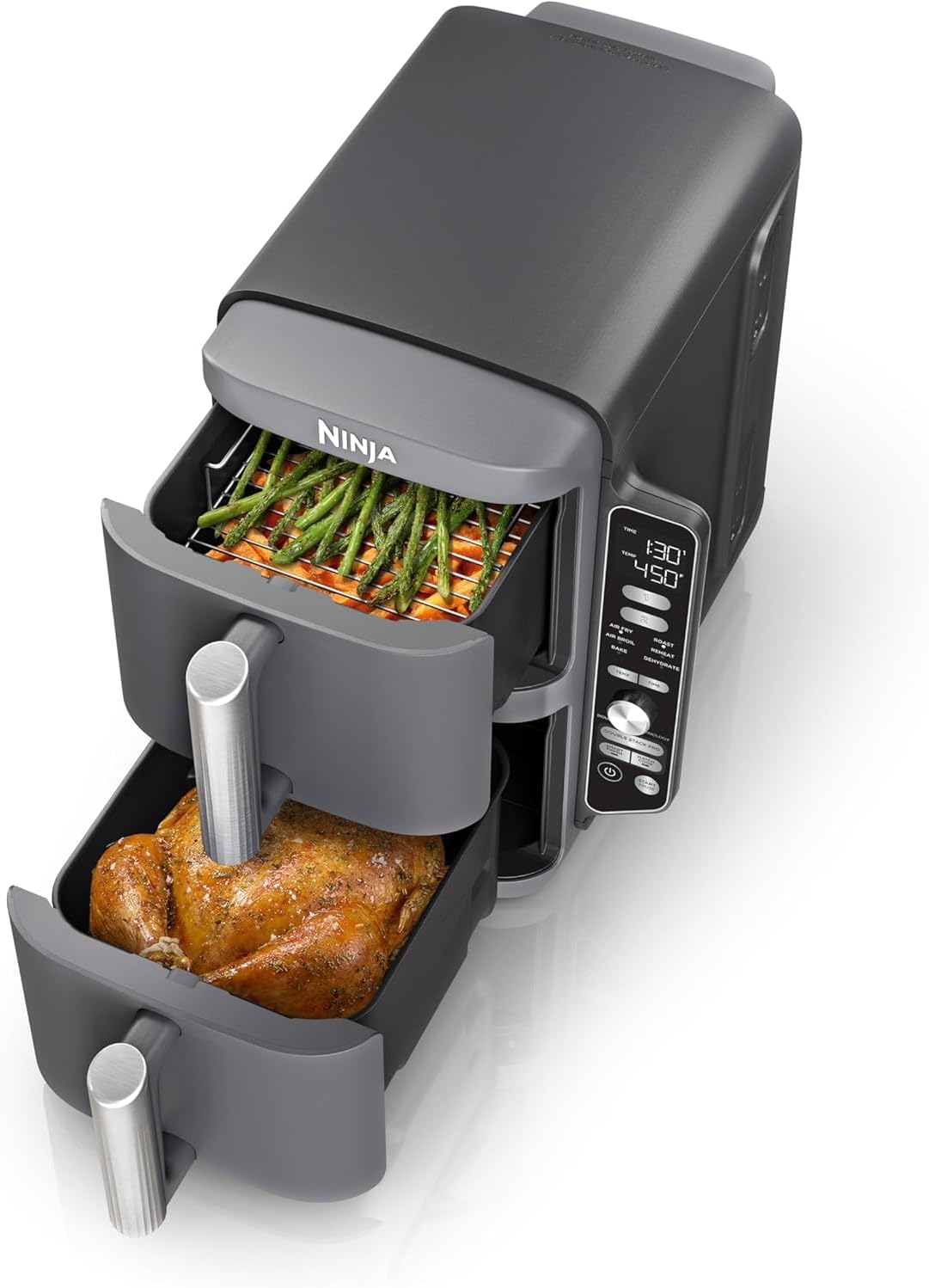
To solve that specific complaint, Ninja launched the Ninja DoubleStack XL (SL401). By rearranging the two 5-quart cooking baskets into a vertical over-and-under layout, Ninja shrunk the width from 17.1 inches down to a sleek 11.25 inches, saving up to 40% of horizontal counter space while retaining the full 10-quart cooking capacity. Even better, they introduced multi-tier wire racks that turn two baskets into four simultaneous cooking levels.
However, changing the orientation of an air fryer fundamentally alters kitchen ergonomics, cabinet clearance, and convective thermodynamics. This in-depth comparison analyzes published manufacturer specifications, heating architectures, cleaning routines, and daily practicality to help you choose the best machine for your kitchen layout.
Dimensional Engineering and Countertop Footprint
The most immediate difference between these two appliances is how they physically occupy your kitchen counter.
The Ninja DoubleStack XL (SL401) Footprint
The DoubleStack XL measures 11.25 inches wide, 19.25 inches deep, and 15.2 inches tall. Its narrow width is an immediate revelation. It slides neatly into tight spaces between a refrigerator and a sink or slots cleanly next to a microwave without dominating the workspace.
However, physics requires that displaced volume go somewhere. While the DoubleStack is nearly 6 inches narrower than the DualZone, it is 5.35 inches deeper and 2.4 inches taller.
At 19.25 inches deep, the DoubleStack extends farther forward toward the front rim of standard 24-inch or 25-inch deep kitchen counters. Furthermore, at 15.2 inches tall, you must measure your kitchen cabinets before buying. While standard American building codes specify 18 inches of clearance between upper cabinets and lower countertops, older homes or counters with decorative light valance trims often have only 15 to 16 inches of vertical clearance.
The Ninja Foodi DualZone XL (DZ401) Footprint
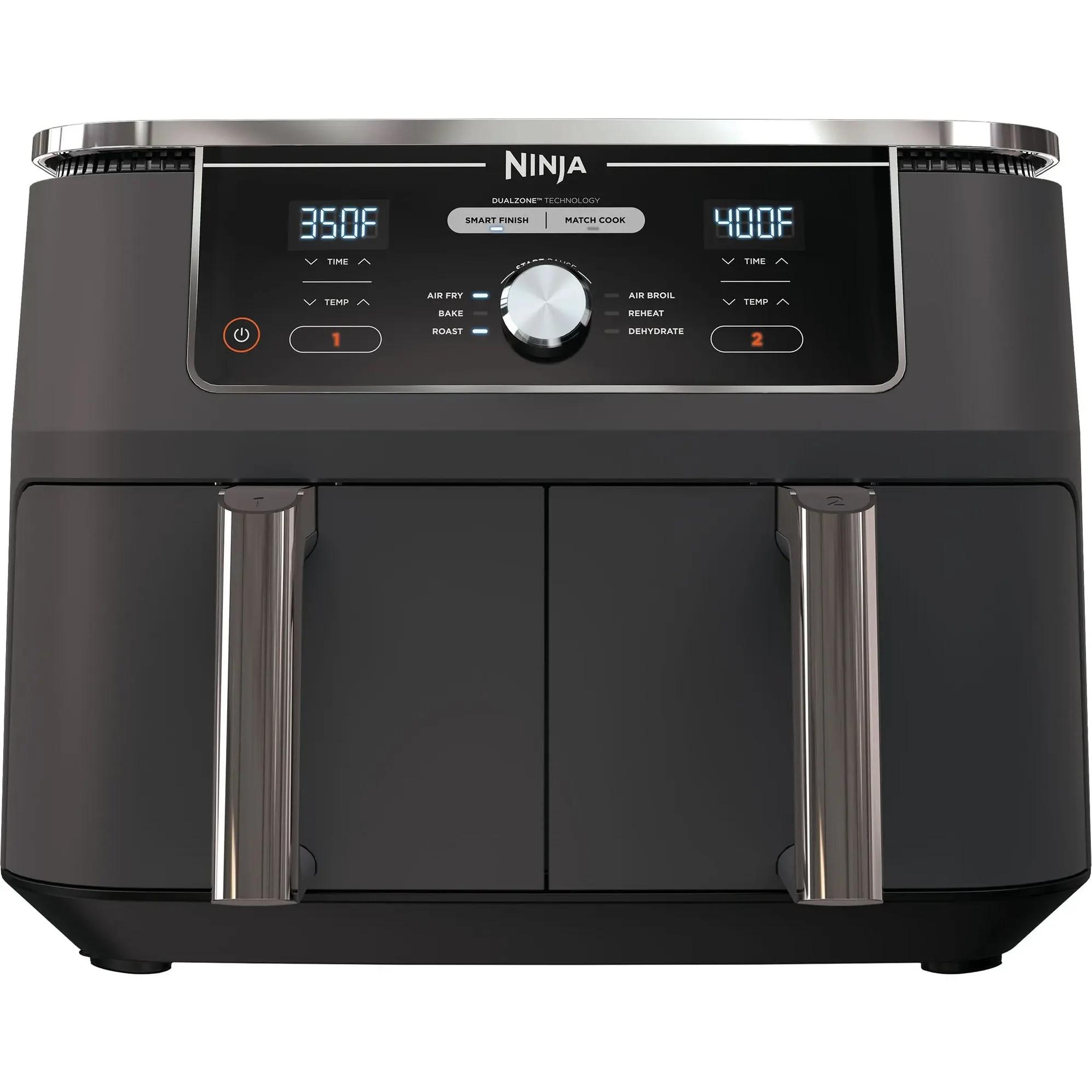
The classic DualZone XL measures 17.1 inches wide, 13.9 inches deep, and 12.8 inches tall. Its wide, broad-shouldered profile gives it a commanding presence on the counter. If you have an expansive kitchen island or long uninterrupted granite countertops, its width is manageable.
The significant advantage of the DualZone's form factor is its height: at just 12.8 inches tall, it provides over 5 inches of breathing room beneath standard 18-inch upper cabinets. You can easily pull the baskets in and out, inspect food, and wipe down the exterior without cabinet doors or decorative trims getting in the way.
Airflow Thermodynamics: Rear-Mounted vs. Top-Down Cyclonic Heating
The shift from a side-by-side arrangement to a stacked vertical tower forced Ninja's mechanical engineers to completely rethink how air circulates through the cooking chambers.
Rear-Mounted Convection in the DoubleStack XL
In a traditional air fryer, the heating coil and high-velocity fan sit directly above the food basket, blasting hot air straight down. In a vertically stacked appliance, placing a heating element and motor above the bottom basket was impossible without making the machine over 22 inches tall.
Instead, Ninja engineered a rear-fan convective architecture. In the DoubleStack XL, each basket has its own dedicated heating element and fan mounted vertically in the rear wall of the chamber.
When active, the fans blow heated air horizontally from the back of the drawer forward across the food, venting through engineered exhaust channels along the sides and front. This horizontal airflow delivers remarkably even baking and roasting across the entire floor of the basket. It also prevents the common issue of top-down scorching, where sugar-glazed chicken wings or breaded cutlets burn on the top surface before the center is cooked through.
Top-Down Cyclonic Airflow in the Foodi DualZone XL
The Foodi DualZone XL uses the proven, classic convective layout: each 5-quart basket sits directly beneath its own independent top-mounted heating element and downward-facing cyclonic fan.
This downward velocity creates an aggressive vortex that forces hot air through the bottom perforations of the nonstick crisper plate, reflecting heat back upward against the bottom of the food. For foods that demand instant surface dehydration and crackling crusts, such as frozen french fries, breaded mozzarella sticks, and chicken nuggets, top-down cyclonic airflow delivers faster initial crisping than rear-fan designs.
Cooking Capacity: The 4-Tier DoubleStack Advantage
Both appliances boast a total rated capacity of 10.0 quarts, divided evenly into two 5.0-quart cooking drawers. In both machines, each drawer can hold up to 5 pounds of chicken wings or a 6-pound whole chicken.
Where the DoubleStack XL surges ahead is with its included DoubleStack stainless steel wire racks.
In conventional dual-basket air fryers like the DZ401, you are limited to two cooking surfaces: the bottom floor of Basket 1 and the bottom floor of Basket 2. If you try to pile sliced zucchini or sweet potato fries on top of chicken thighs in the same basket, the trapped moisture causes the food to steam rather than crisp.
The DoubleStack XL solves this by providing custom-fitted elevated wire racks that clip inside each drawer. This effectively doubles your usable cooking levels from two to four:
- Bottom Drawer Floor: 4 marinated chicken breasts roasting at 375°F.
- Bottom Drawer Wire Rack: Seasoned green beans and cherry tomatoes crisping above the chicken.
- Top Drawer Floor: Diced rosemary garlic potatoes roasting at 400°F.
- Top Drawer Wire Rack: Garlic bread slices toasting during the final four minutes.
Because the rear-mounted fans circulate air horizontally across both the upper rack and the lower floor, all four items cook simultaneously with proper air circulation. For families who want complete multi-course dinners cooked entirely in a single appliance, the 4-tier capability of the DoubleStack is a transformative upgrade.
Weeknight Synchronization: Smart Finish and Match Cook
Both models share Ninja's proprietary dinner coordination technology, controlled via dedicated buttons on their digital panels.
Smart Finish Mode
The greatest asset of owning two independent cooking zones is the Smart Finish button. Suppose you are cooking salmon fillets in Zone 1 (which require 400°F for 12 minutes) and thick roasted potato wedges in Zone 2 (which require 375°F for 24 minutes).
Without Smart Finish, you would have to stand in the kitchen watching a clock to manually turn on Zone 1 twelve minutes after Zone 2 started. With Smart Finish engaged, you input the settings for both zones and press Start. The machine immediately starts cooking the potatoes in Zone 2 while holding Zone 1 in standby. Exactly 12 minutes later, Zone 1 automatically activates. Both compartments chime and complete cooking at the exact same second, so dinner hits the table completely fresh and hot.
Match Cook Mode
When hosting weekend gatherings, game-day parties, or batch-cooking snacks for the week, you often want both drawers doing the exact same thing. Pressing the Match Cook button instantly copies your chosen time, temperature, and cooking mode from Zone 1 over to Zone 2. You can effortlessly cook 10 pounds of buffalo chicken wings or 4 pounds of french fries without setting the two sides independently.
Daily Ergonomics: Drawer Pulls, Control Layouts, and Viewing
Countertop appliances live and die by ease of use. How you interact with these machines twice a day makes a substantial difference in long-term satisfaction.
Controls and Display Positioning
The Foodi DualZone features a wide, centrally positioned control console across the top middle of the unit. The digital buttons are large, angled slightly upward for effortless reading, and cleanly separated between Zone 1 (left) and Zone 2 (right).
Because the DoubleStack XL stacks its baskets vertically, Ninja could not place the buttons between them. Instead, they placed the control console on a vertical column along the right side of the unit. An illuminated dial and toggle button let you switch between Top and Bottom baskets. While it takes three or four dinners to build muscle memory for the vertical layout, the display is bright, responsive, and clearly labeled.
Basket Weight and Handling
Pulling drawers in and out of the DualZone DZ401 feels balanced because the drawers are side by side at counter height. Each drawer slides straight out horizontally without altering the unit's center of gravity.
On the DoubleStack XL, the lower drawer sits right at counter level, while the upper drawer sits roughly 8 inches higher. Pulling out the top drawer when it is loaded with heavy food requires a steady grip, but Ninja engineered sturdy, ergonomic handles with internal thermal heat shields that stay completely cool to the touch.
Cleaning, Nonstick Durability, and Dishwasher Safety
Nobody enjoys scrubbing burnt grease out of corners. Both appliances use Ninja's ceramic nonstick coating on the interior surfaces of the cooking drawers and crisper plates.
This ceramic coating is completely PTFE-free, PFOA-free, and cadmium-free. Unlike cheaper Teflon coatings that can degrade or flake after repeated heating cycles, Ninja's ceramic finish is slick and resilient. Food residue, caramelized barbecue sauces, and melted cheese wipe away effortlessly under warm running water using a soft sponge and mild dish soap.
Both the drawers and crisper plates from both models are officially labeled dishwasher safe. However, the cleaning burden between the two models differs based on the wire racks:
- Foodi DualZone Cleaning: You wash only two drawers and two flat crisper plates. The interior is straightforward and fast to clean.
- DoubleStack XL Cleaning: When you take advantage of 4-tier cooking, you have two drawers, two crisper plates, and two stainless steel wire racks to clean. While the wire racks are dishwasher safe, food particles like charred chicken skin can stick to the wire intersections, occasionally requiring a quick scrub with a nylon bristle brush before loading into the dishwasher.
Scenario Matchups: Which Air Fryer Should You Choose?
Scenario 1: Compact Kitchens, Apartments, and Townhomes
Winner: Ninja DoubleStack XL (SL401)
If you have less than 4 feet of open counter space, the DoubleStack XL is a must-buy. At 11.25 inches wide, it takes up no more space than a standard single-basket air fryer while delivering the massive 10-quart capacity and two independent zones required for serious family cooking.
Scenario 2: Kitchens with Low Upper Cabinets (Under 16 Inches Clearance)
Winner: Ninja Foodi DualZone XL (DZ401)
If your upper cabinets hang low or feature thick decorative trim moldings, the 12.8-inch height of the DualZone provides safe, stress-free clearance. It tucks neatly under cabinets without obstructing airflow or venting steam directly against wood cabinet finishes.
Scenario 3: Multi-Course Weeknight Meals (Proteins + Two Sides)
Winner: Ninja DoubleStack XL (SL401)
If your typical dinner consists of a main protein (salmon, steak, or chicken) along with two distinct vegetables (roasted broccoli and baby potatoes), the DoubleStack's included wire racks let you cook all three or four components simultaneously without flavor cross-contamination or steaming.
Scenario 4: Traditional Finger Foods and Aggressive Top-Down Browning
Winner: Ninja Foodi DualZone XL (DZ401)
If your family primarily cooks frozen appetizers, chicken nuggets, mozzarella sticks, and french fries where intense top-down radiant heat is needed for deep crunch, the classic overhead cyclonic fans on the DualZone deliver slightly faster surface crisping.
The Bottom Line
Both the Ninja DoubleStack XL (SL401) and the Ninja Foodi DualZone XL (DZ401) represent the highest tier of dual-basket countertop convenience. Both provide 10.0 quarts of total capacity, 1,690 watts of cooking power, independent temperature control up to 450°F, and the dinner-synchronizing brilliance of Smart Finish and Match Cook.
Your decision rests entirely on your kitchen's physical dimensions and your cooking style.
The Ninja DoubleStack XL (SL401) is the superior modern design for most households. By building upward instead of outward, it frees up critical counter space, while its rear-mounted convection fans and 4-tier wire rack system allow you to prepare complex, multi-component dinners in a remarkably compact footprint.
The Ninja Foodi DualZone XL (DZ401) remains the classic powerhouse for kitchens with generous horizontal counter space. Its low-profile 12.8-inch height guarantees effortless clearance under low cabinets, its centered controls are immediately intuitive, and its overhead cyclonic fans deliver maximum surface crisping with simpler cleanup.
If counter space is at a premium and multi-tier cooking appeals to your dinner routine, buy the DoubleStack XL. If you have plenty of room on your counter and want a low-profile, time-tested dual-basket workhorse, the Foodi DualZone XL is an outstanding choice.