Struggling with digital eye strain, visual fatigue, or late-night insomnia? We examine the optical physics of electrophoretic reflective E-Ink versus self-emissive OLED screens, PWM flicker sensitivity, and circadian melatonin suppression.

Choose E-Ink for dedicated reading, note-taking, writing, and late-night study without eye strain or sleep disruption. Choose OLED for smartphones, multimedia streaming, gaming, and creative visual work.
Both Reflective E-Ink and Emissive OLED are great options, but they work differently and offer distinct advantages.
Reflective microcapsule screen that reflects ambient light naturally like printed ink on physical paper.
Direct per-pixel organic light emission delivering infinite contrast and fluid 120Hz high-refresh animations.

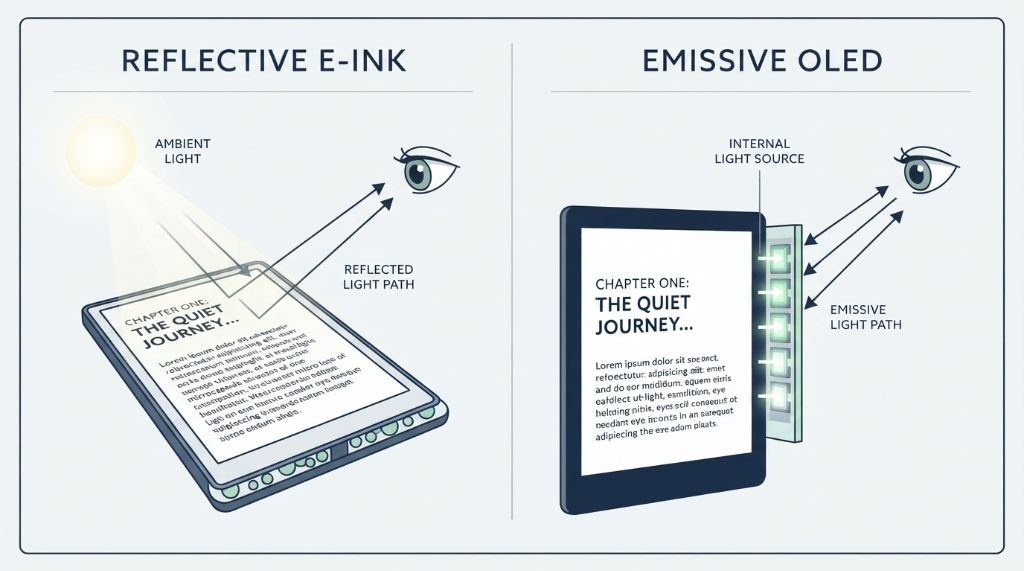
The primary difference in ocular comfort between display technologies lies in how photons reach your retinas. OLED displays are self-emissive; every microscopic pixel is an active organic diode projecting direct light forward into your eyes. Staring at an OLED display is physically equivalent to looking directly at thousands of tiny light bulbs. In contrast, Electronic Ink (E-Ink / EPD) displays are electrophoretic and purely reflective. They contain millions of microcapsules filled with positively charged white titanium dioxide particles and negatively charged black carbon particles suspended in clear fluid. By reflecting ambient environmental room light or sunlight rather than firing light forward, E-Ink mimics physical ink on paper, significantly reducing visual discomfort during long reading and writing sessions.
Many modern smartphone and laptop OLED displays control brightness using Pulse-Width Modulation (PWM), rapidly cycling the panel between on and off states at frequencies between 240Hz and 480Hz. While imperceptible to conscious vision, PWM flickering causes microscopic pupil oscillations that can trigger eye strain, dry eyes, and tension headaches in flicker-sensitive individuals—especially in low-light environments. Furthermore, emissive OLED screens emit concentrated short-wavelength blue light (450nm–460nm), which suppresses nocturnal melatonin secretion in the pineal gland, disrupting sleep architecture. The bistable E-Ink display is inherently zero-flicker: once black/white particles form an image, the screen requires zero electrical current to maintain it.
OLED displays are engineered for high-refresh fluid motion (90Hz to 120Hz+), making them sublime for rendering fast-paced animations, 4K video playback, and gaming. However, this fluid interactivity encourages compulsive notification checking, social doomscrolling, and app multitasking. E-Ink screens operate at deliberate, low refresh rates (typically 1Hz to 15Hz), rendering them unsuitable for gaming or video, but creating an intentional, distraction-free environment for deep reading, code analysis, and document review.
E-Ink displays mimic physical paper, letting you read 500-page textbooks and PDF research papers for hours without eye strain or headaches.
OLED provides wide DCI-P3 color gamuts, instant 0.03ms pixel switching, and HDR highlights required for video games and creative illustration.
E-Ink's warm lateral frontlight illuminates the page without direct blue light emission, preserving melatonin levels and sleep quality.
OLED delivers cinema-grade contrast with pure blacks and fluid 120Hz scrolling for streaming and multimedia apps.
If your primary goal is reading books, reviewing documents, or writing distraction-free without digital eye strain or late-night sleep disruption, an E-Ink display is the healthiest and most comfortable screen technology available. If you need rich color, fast UI response, video playback, and creative editing capabilities, an OLED screen remains the undisputed multimedia king.
Yes, if the device includes an integrated frontlight. Unlike OLED backlights that shine directly toward your retinas, E-Ink frontlights use tiny LEDs embedded along the bezel that disperse soft, warm light laterally across a transparent light-guide sheet, illuminating the page like a bedside lamp.
Explore related technical deep-dives and actionable buying guides.
