Debating between all-in-one (AIO) liquid cooling loops and modern solid phase-change thermal materials (like PTM7950) paired with air coolers? We analyze thermal conductivity, pump-out degradation, pump failure risks, and long-term maintenance.
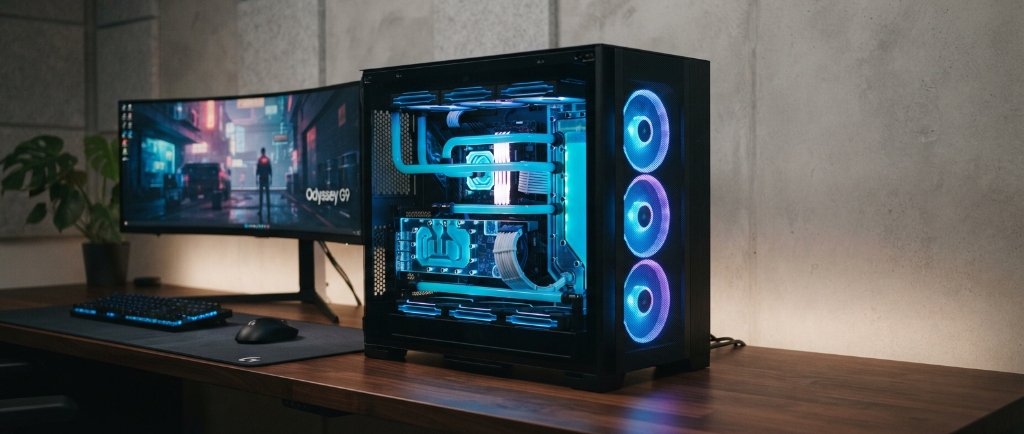
Choose Phase-Change Pads (PTM7950) paired with a dual-tower air cooler for a durable, maintenance-free gaming PC. Choose a 360mm AIO liquid cooler for heavily overclocked 250W+ workstation chips.
Both Liquid AIO Cooling and Phase-Change Pads + Air Cooling are great options, but they work differently and offer distinct advantages.
Continuous water circulation through a copper cold plate and 240mm–360mm finned radiator.
Solid polymer sheets that melt at 45°C to form an ultra-thin, pump-out-resistant thermal interface.
Modern high-performance desktop processors and GPUs (such as Intel Core Ultra 9, AMD Ryzen 9 9000-series, and Nvidia RTX 40/50-series graphics cards) concentrate immense thermal loads exceeding 250 to 450 watts into silicon dies measuring less than 200 mm². Managing these extreme thermal flux densities has ignited a fierce debate in PC hardware engineering between All-In-One (AIO) Liquid Cooling systems and next-generation Solid Phase-Change Thermal Interface Materials (PTM) paired with dual-tower air heatsinks.
Standard silicone-based thermal pastes suffer from a catastrophic mechanical failure mode known as "pump-out." As a CPU rapidly cycles between 35°C idle and 95°C full load, microscopic expansion and contraction of the copper IHS (Integrated Heat Spreader) pushes viscous thermal paste outward toward the die perimeter, leaving dry air gaps in the center that cause sudden thermal throttling within 6 to 18 months. Phase-change materials (such as polymer-based Honeywell PTM7950) remain solid at room temperature for easy, mess-free application, but transition into a liquid phase at approximately 45°C. In its liquid state, the material fills microscopic surface voids at the molecular level, delivering exceptional thermal conductivity (8.5 W/m-K) while remaining trapped under surface tension to permanently resist pump-out degradation over 5+ years of daily thermal cycling.
Liquid cooling loops operate on the superior specific heat capacity of water, utilizing a closed copper cold-plate block, flexible ethylene propylene diene monomer (EPDM) tubing, and a 240mm to 360mm aluminum radiator equipped with high-static-pressure fans. Liquid coolers excel at absorbing sudden, aggressive burst workloads—the fluid acts as a massive thermal buffer, keeping CPU temperatures 5°C to 10°C cooler during prolonged multi-core 3D rendering and overclocking benchmarks. However, liquid coolers introduce inherent mechanical failure vectors: electric water pump impeller seizure, micro-permeation coolant evaporation over 3 to 5 years, and catastrophic coolant leak risks that can destroy underlying motherboard and GPU components.
When engineering your PC build, evaluate your acoustic tolerances and maintenance philosophy. If you demand whisper-quiet operation during 100% sustained Cinebench or Blender multi-hour renders and have a spacious PC case that accommodates 360mm top radiator mounts, a premium 360mm AIO liquid cooler delivers unbeatable thermal headroom. If you prefer a set-and-forget workstation with zero pump noise, zero leak anxiety, and an indefinite 10-year lifespan, pairing a solid phase-change pad with a dual-tower air cooler provides near-identical real-world gaming frame rates with zero maintenance overhead.
360mm liquid AIO loops absorb continuous 300W rendering workloads, keeping CPU package thermals stable under hour-long multi-core exports.
Phase-change pads like PTM7950 are ideal for bare laptop silicon dies, permanently solving severe pump-out throttling without short-circuit risks.
Phase-change materials paired with large air coolers eliminate water pump whine, allowing fans to stop completely for dead-silent desktop operation.
Combining PTM7950 with an all-metal dual-tower heatsink creates a fail-safe system that runs at peak thermal efficiency for years without fluid top-ups.
If you are running an unlocked flagship processor for extreme multi-core rendering and demand the lowest possible thermal ceiling, a 360mm AIO liquid cooler delivers unrivaled heat capacity. For 95% of PC gamers and system builders seeking an unkillable, set-and-forget system with zero pump failure risk or paste degradation, pairing a phase-change pad (PTM7950) with a premium air cooler is the smarter, more reliable choice.
Yes, especially over long periods. While liquid thermal pastes (like Kryonaut or Arctic MX-6) perform well on day one, they degrade rapidly due to pump-out and dry-out effects. Phase-change pads liquefy at 45°C to achieve near-liquid-metal thermal impedance with zero electrical conductivity risk, maintaining peak heat transfer for 5+ years without drying out.
Explore related technical deep-dives and actionable buying guides.
