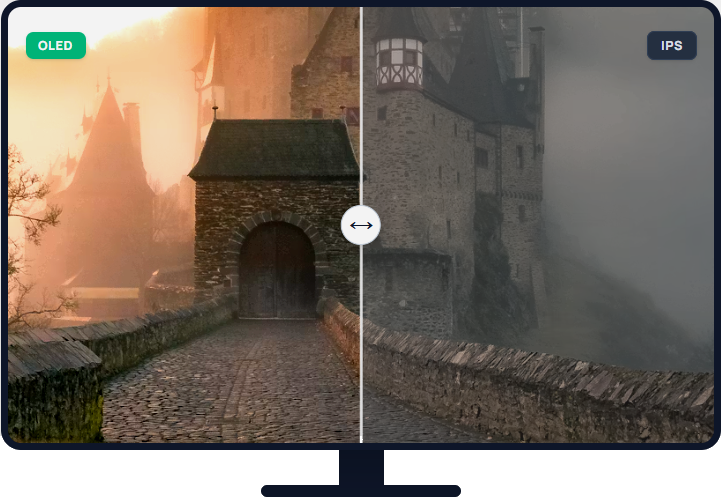
Choose OLED for immersive dark-room gaming, HDR movies, and color grading. Choose IPS for bright-room office productivity, programming, reading documents, and budget value.
Both OLED Displays and IPS LCD Displays are great options, but they work differently and offer distinct advantages.
Self-emissive organic pixels deliver infinite contrast, true 0-nit blacks, and instant 0.03ms pixel switching.
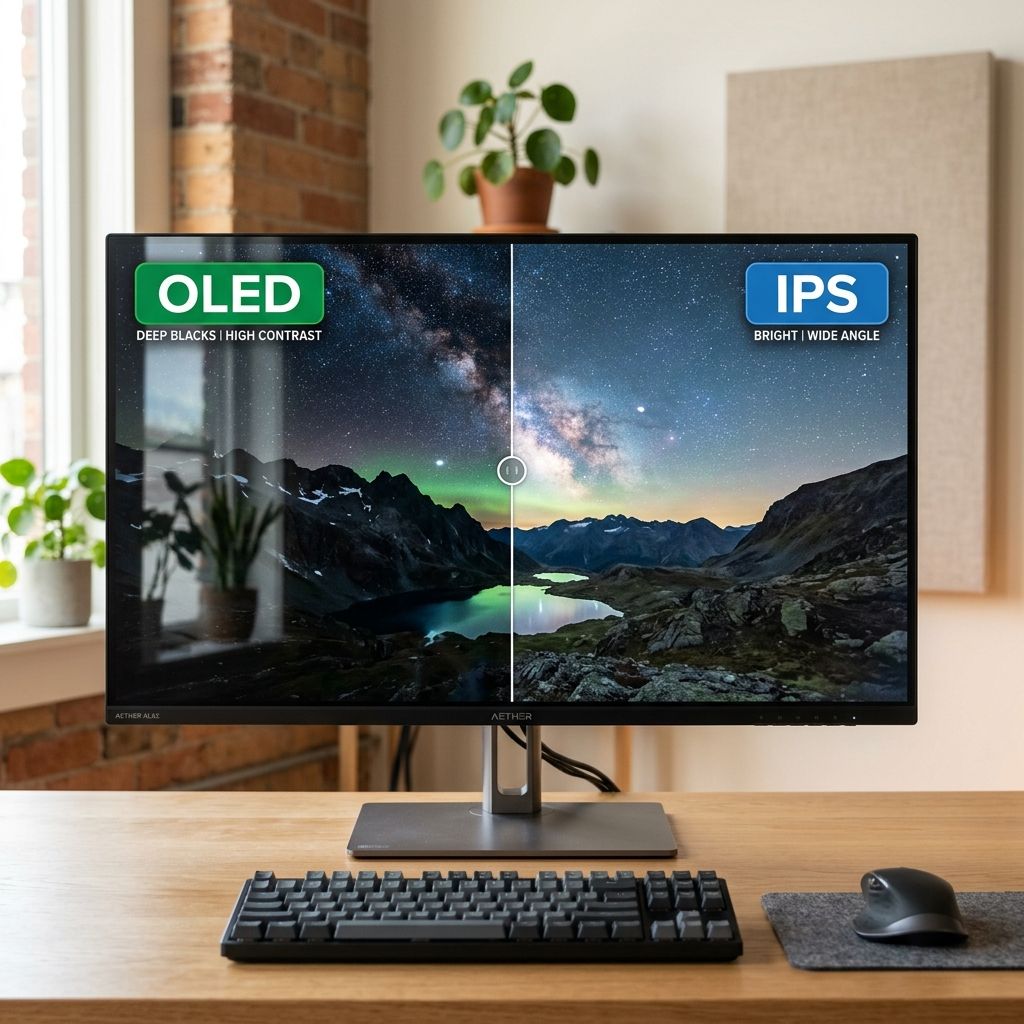
In-plane switching liquid crystals illuminated by an LED backlight provide uniform brightness and crisp text.
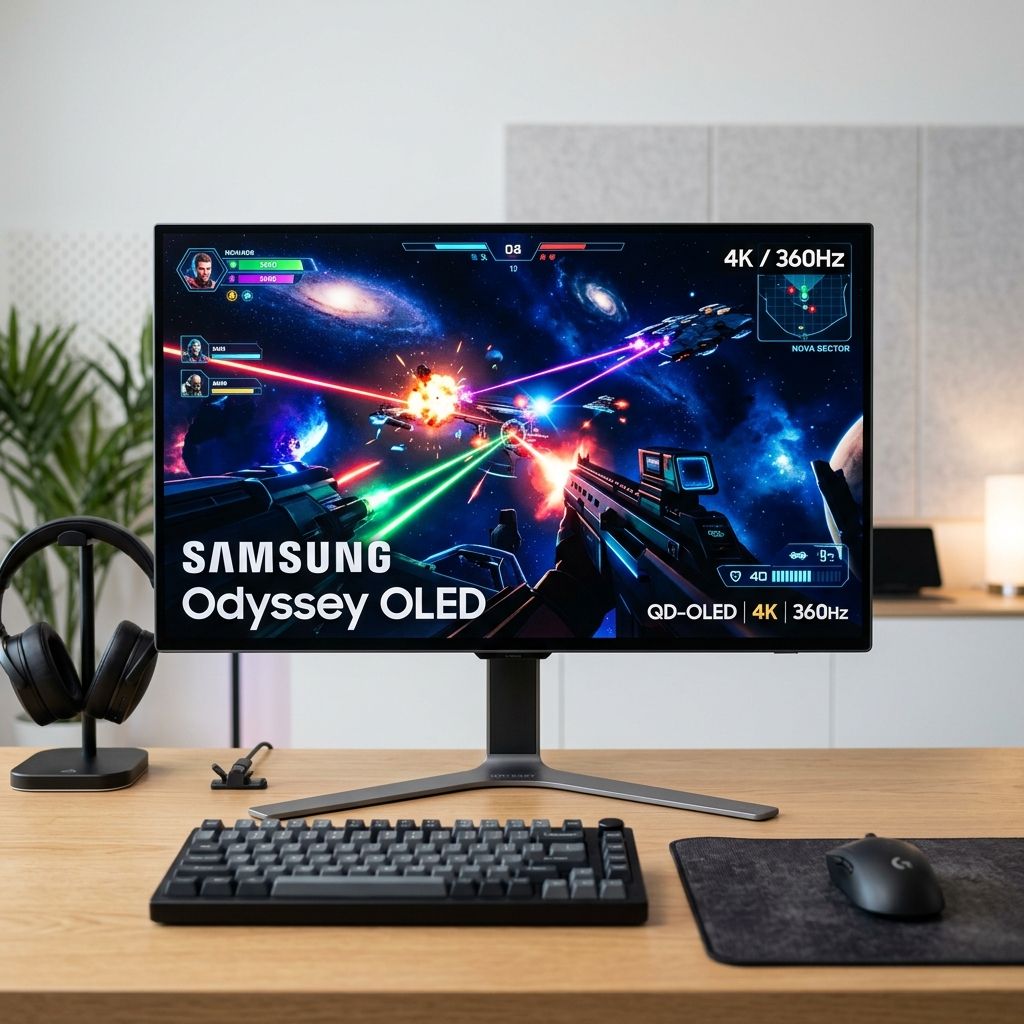
The battle between OLED (Organic Light Emitting Diode) and IPS (In-Plane Switching LCD) represents the defining technological contest in modern TVs, gaming monitors, and laptops. While IPS panels rely on a constant LED backlight shining through polarized layers of liquid crystals to filter light, OLED panels are self-emissive. Every individual subpixel in an OLED display generates its own luminance and can turn completely off at the per-pixel level, achieving a true 0.00-nit black floor and a theoretically infinite (∞:1) contrast ratio.
Because IPS liquid crystals cannot physically block 100% of the underlying backlight, black scenes exhibit light leakage, resulting in static contrast ratios between 1,000:1 and 2,000:1 (often appearing as dark charcoal gray or exhibiting "IPS glow" in dark rooms). OLED eliminates haloing and backlight bleed completely. Furthermore, because OLED changes pixel state via electrical current rather than physically twisting liquid crystal molecules, its pixel response time is instantaneous—measuring an astonishing 0.03 milliseconds compared to 1ms to 4ms on Fast-IPS panels. This virtually eliminates ghosting and motion blur in fast-paced competitive esports.
Where IPS LCDs maintain a commanding advantage is in static office productivity and bright-room environments. IPS panels utilize a standard vertical RGB stripe subpixel layout, rendering crisp, razor-sharp font rendering in Windows and macOS without color fringing. In contrast, certain QD-OLED (triangular subpixel) and WOLED (white subpixel) panels can exhibit slight magenta/green color fringing along fine text edges. Moreover, IPS monitors can sustain 400 to 1,000+ nits of full-screen 100% white brightness indefinitely without dimming, whereas OLED panels deploy aggressive Automatic Brightness Limiters (ABL) to prevent thermal overload and burn-in.
Modern 3rd-generation OLED monitors incorporate advanced graphene heatsinks, pixel shifting, pixel cleaning cycles, and 3-year burn-in warranties. For dark-room movie viewing, HDR gaming, and creative photo grading, OLED delivers an unmatched, breathtaking visual experience. However, if your daily workflow involves 8+ hours of static spreadsheets, writing documents, and web browsing in a sunlit home office with windows behind you, a high-refresh Fast-IPS monitor provides superior daylight readability, crisp text, and zero burn-in anxiety at a significantly lower cost.
OLED delivers flawless 0.03ms motion clarity in FPS titles and jaw-dropping contrast in rich cinematic HDR worlds like Cyberpunk.
OLED's zero-nit blacks eliminate letterbox bar glow, delivering authentic movie theater contrast in dark rooms.
IPS monitors provide razor-sharp text clarity, non-fluctuating full-screen white backgrounds, and zero burn-in anxiety across 10-hour coding days.
High-nit IPS displays overpower window glare easily with anti-glare matte coatings and high sustained full-screen brightness.
If your primary use is gaming, HDR movie watching, and content creation in a moderately dim room, OLED delivers a transcendent visual upgrade with infinite contrast and instantaneous 0.03ms pixel response. If you work 8+ hours a day on spreadsheets, coding, or reading documents in a sunlit room, a high-quality Fast-IPS display is the more practical, durable, and cost-effective daily tool.
While modern OLED displays feature pixel shift, logo luminance reduction, and custom graphene heatsinks to resist permanent image retention, displaying static Windows taskbars, browser chrome, or Excel gridlines at maximum brightness 8 hours a day can still degrade organic subpixels over several years. For static productivity, IPS is significantly safer.
Explore related technical deep-dives and actionable buying guides.